Concrete Anchor Drilling Services in Dubai

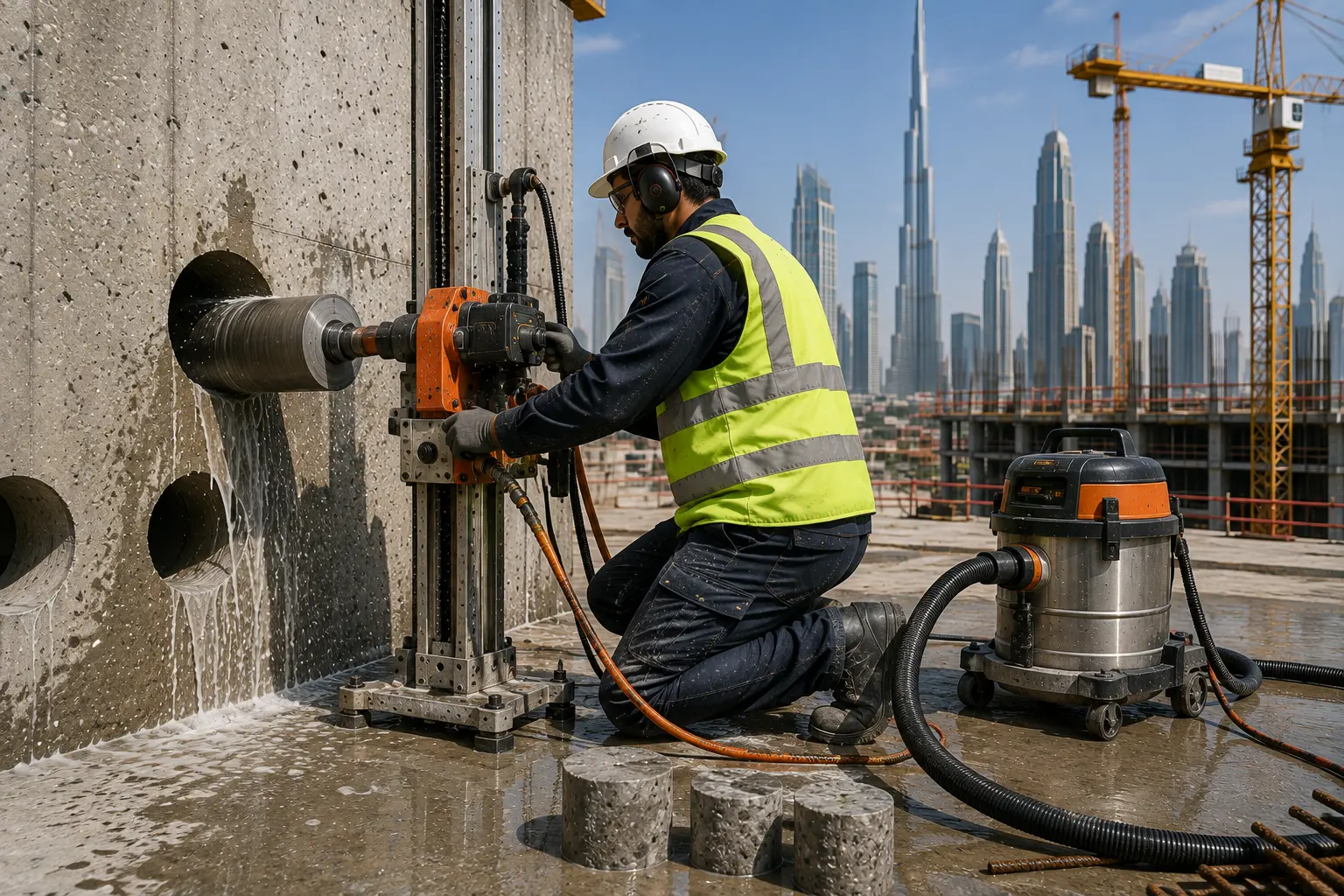
Not every concrete drilling job calls for a hollow core bit passing all the way through a wall or slab. Many construction and installation projects require small, precise holes drilled to a specific depth for anchor bolts, rebar dowels, or structural fixtures—a technique known as concrete anchor drilling. Getting these holes right, in exact position and depth, is essential for the safety and load-bearing performance of whatever is being fixed in place. At Rizwan Anwar Technical Services LLC, we provide professional concrete anchor drilling services in Dubai for residential, commercial, and industrial projects. In this guide, we’ll explain what concrete anchor drilling involves, how it differs from core cutting, where it’s commonly used, and why precision matters so much in this type of work. What Is Concrete Anchor Drilling? Concrete anchor drilling is the process of drilling precise, non-through holes into concrete to install anchor bolts, expansion anchors, chemical anchors, or rebar dowels. Unlike core cutting, which creates a hollow opening all the way through a wall or slab, anchor drilling typically produces a solid hole of a specific diameter and depth, into which a fastener or reinforcing bar is inserted and secured. This technique relies on rotary hammer drills fitted with carbide or diamond-tipped bits, allowing for accurate depth control and clean hole walls — both of which are critical for the anchor or dowel to achieve its full holding strength. Concrete anchor drilling is a foundational part of structural connections, equipment mounting, and reinforcement work across construction projects of all sizes. Select concrete anchor drilling services are typically required whenever new structural elements, machinery, railings, or fixtures need to be securely fastened to existing concrete surfaces. Concrete Anchor Drilling Services in Dubai Why Precision in Concrete Anchor Drilling Matters Choosing the right approach and contractor for anchor drilling isn’t just a technical detail — it has a direct impact on the safety and performance of whatever is being installed. Here’s why precision matters so much: 1. Structural Load-Bearing Performance An anchor’s holding strength depends heavily on the hole being drilled to the correct diameter and depth. Poor drilling can significantly reduce the load capacity of the anchor, creating safety risks. Concrete Anchor Drilling Services in Dubai 2. Accurate Positioning Structural connections, machinery mounts, and railing installations often require holes positioned within tight tolerances to align with pre-engineered fixtures or bolt patterns. 3. Clean Hole Walls for Proper Bonding For chemical anchors in particular, the hole walls need to be clean and free of dust or debris to ensure the adhesive bonds properly with the surrounding concrete Anchor Drilling Services in Dubai. 4. Avoiding Damage to Reinforcement Careful drilling helps avoid striking existing rebar or embedded utilities, which could otherwise compromise both the structure and the installation itself. Our Concrete Anchor Drilling Services in Dubai We offer a complete range of anchor drilling solutions tailored to different project requirements across Dubai and the wider UAE: Structural Anchor Bolt Drilling Precise holes for structural steel connections, base plates, and load-bearing fixtures requiring high-strength anchor bolts. Rebar Dowel Drilling Accurate drilling for rebar dowels used to tie new concrete pours into existing structures during extensions or repairs. Machinery and Equipment Mounting Precision anchor holes for securing industrial machinery, HVAC units, and heavy equipment to concrete floors or platforms. Railing and Fixture Installation Anchor drilling for handrails, safety barriers, signage, and other fixtures requiring secure attachment to concrete surfaces. Chemical Anchor Drilling Clean, dust-free holes prepared specifically for chemical anchor systems, where proper hole preparation is critical to adhesive performance. How the Concrete Anchor Drilling Process Works Understanding what to expect from a concrete anchor drilling contractor can help you plan your project more effectively: Layout and Marking Our team marks precise drilling points based on structural drawings or fixture specifications, ensuring correct spacing and alignment. Equipment Selection Depending on the anchor type and required hole diameter, we select the appropriate rotary hammer drill and bit size for the job. Drilling to Specified Depth Each hole is drilled to the exact depth required for the anchor or dowel type, with careful monitoring to avoid over- or under-drilling. Hole Cleaning Dust and debris are removed from each hole, particularly important for chemical anchor applications where clean bonding surfaces are essential. Anchor Installation Support Where needed, we assist with proper anchor or dowel placement to ensure the installation meets structural requirements. Final Inspection Completed holes and installed anchors are inspected for depth, alignment, and cleanliness before handover. Where Concrete Anchor Drilling Is Commonly Used Concrete Anchor Drilling vs. Core Cutting While both techniques involve drilling into concrete, they serve very different purposes: Factor Concrete Anchor Drilling Core Cutting Hole Type Solid, non-through hole Hollow, typically through-wall Primary Purpose Fastening bolts, dowels, fixtures Passing pipes, cables, or ducts Depth Control Critical, must match anchor spec Typically full material thickness Equipment Used Rotary hammer drills Diamond core bits Common Applications Structural connections, mounting Plumbing, electrical, HVAC Choosing the correct technique for your project depends entirely on the intended purpose of the hole — anchor drilling for fastening, core cutting for passage. Equipment We Use Our team uses professional-grade rotary hammer drills fitted with carbide and diamond-tipped bits in a range of diameters, allowing us to handle everything from small fixture installations to larger structural anchor bolt projects. This equipment provides the depth accuracy and clean hole quality necessary for reliable anchor performance. Factors That Affect Concrete Anchor Drilling Cost in Dubai Every project is different, and the cost of concrete anchor drilling typically depends on several factors: Number of Anchor Holes — Projects requiring multiple anchor points naturally involve more drilling time than a single installation. Hole Diameter and Depth — Larger diameter or deeper holes for heavy-duty anchors require more time and specialized bits. Concrete Strength and Reinforcement — Denser concrete or areas with heavy reinforcement can slow drilling and may require careful navigation around rebar. Precision Requirements — Projects with tight tolerance requirements, such as machinery mounting, may require additional layout and verification
Wall Circular Saw Services in Dubai

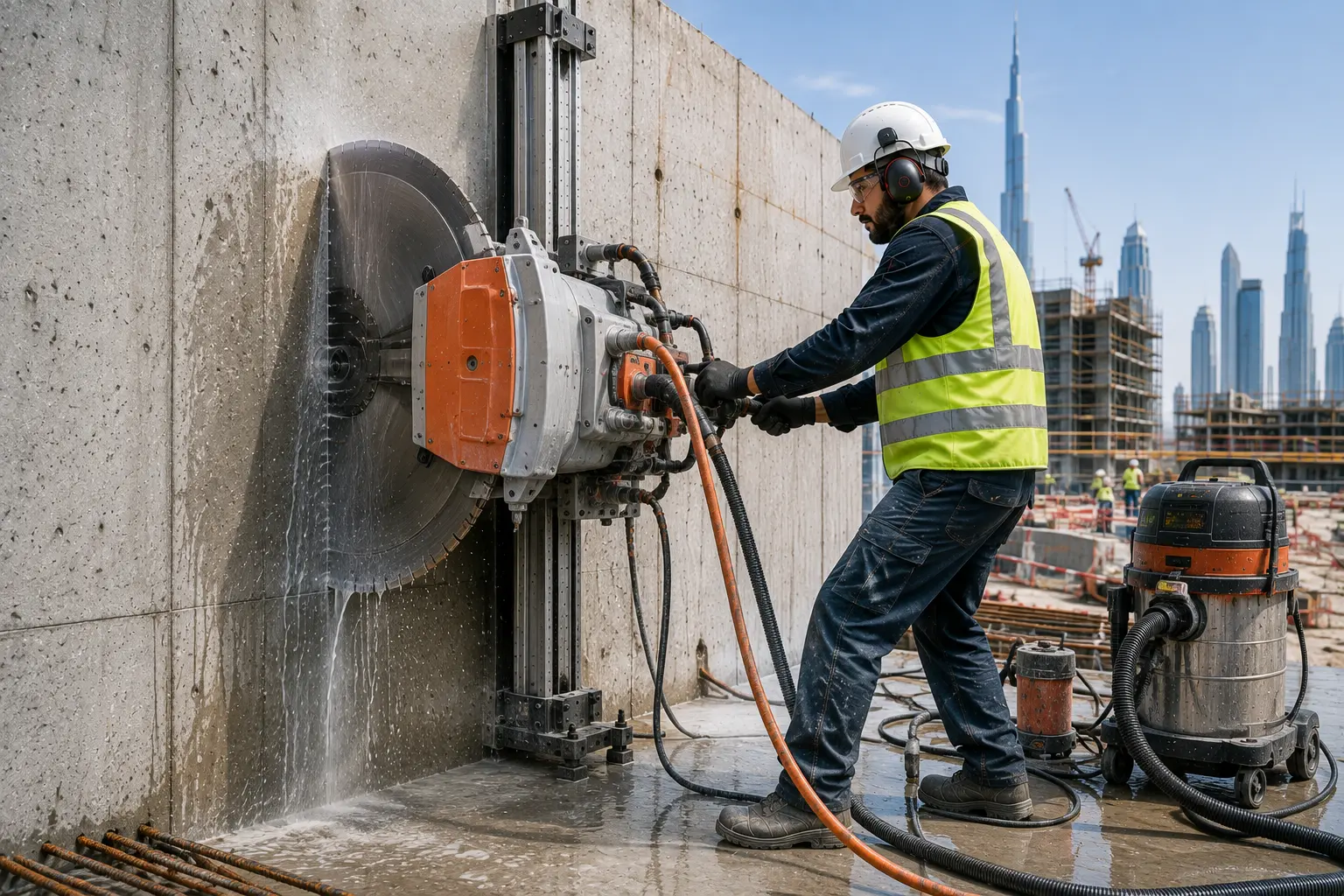
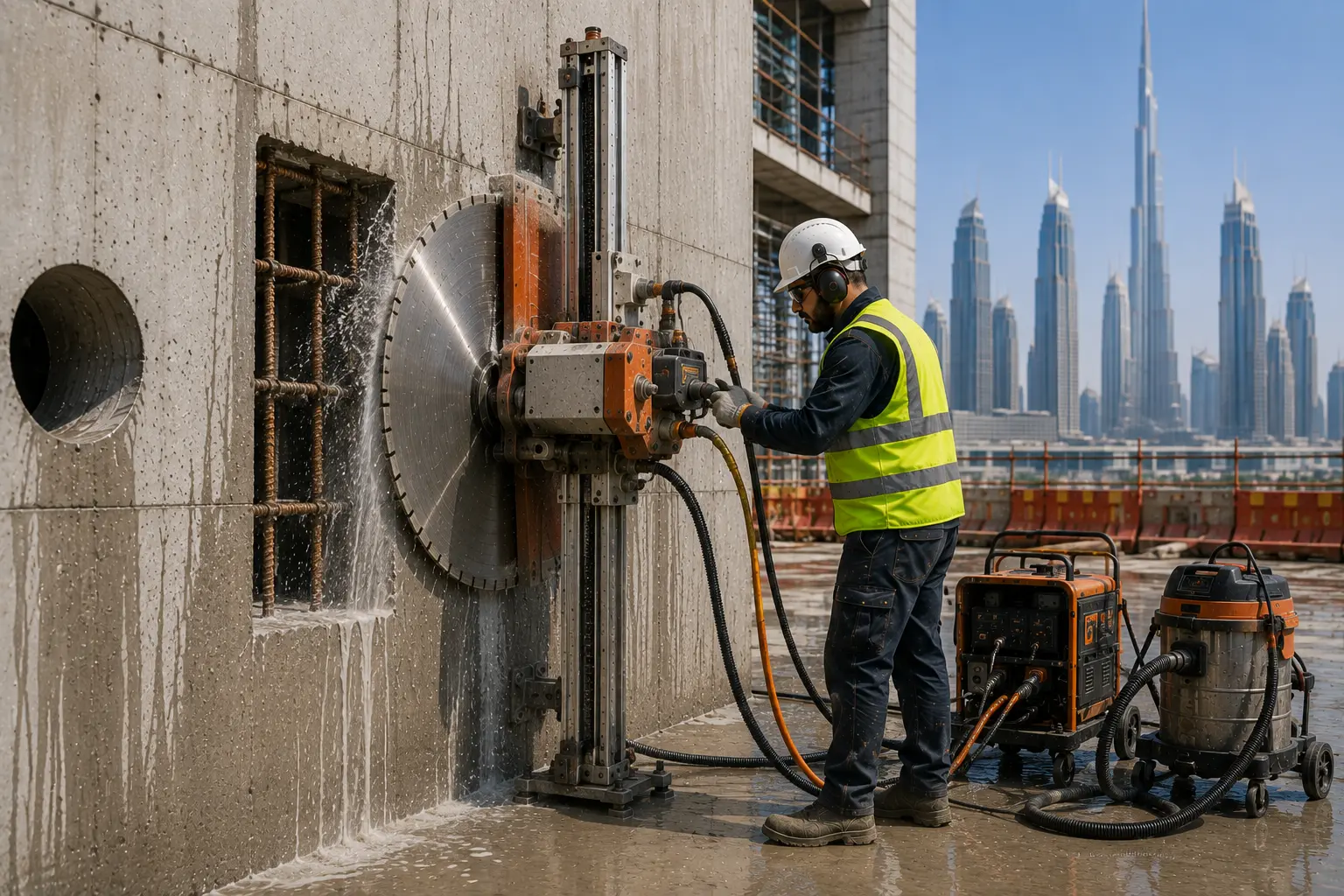
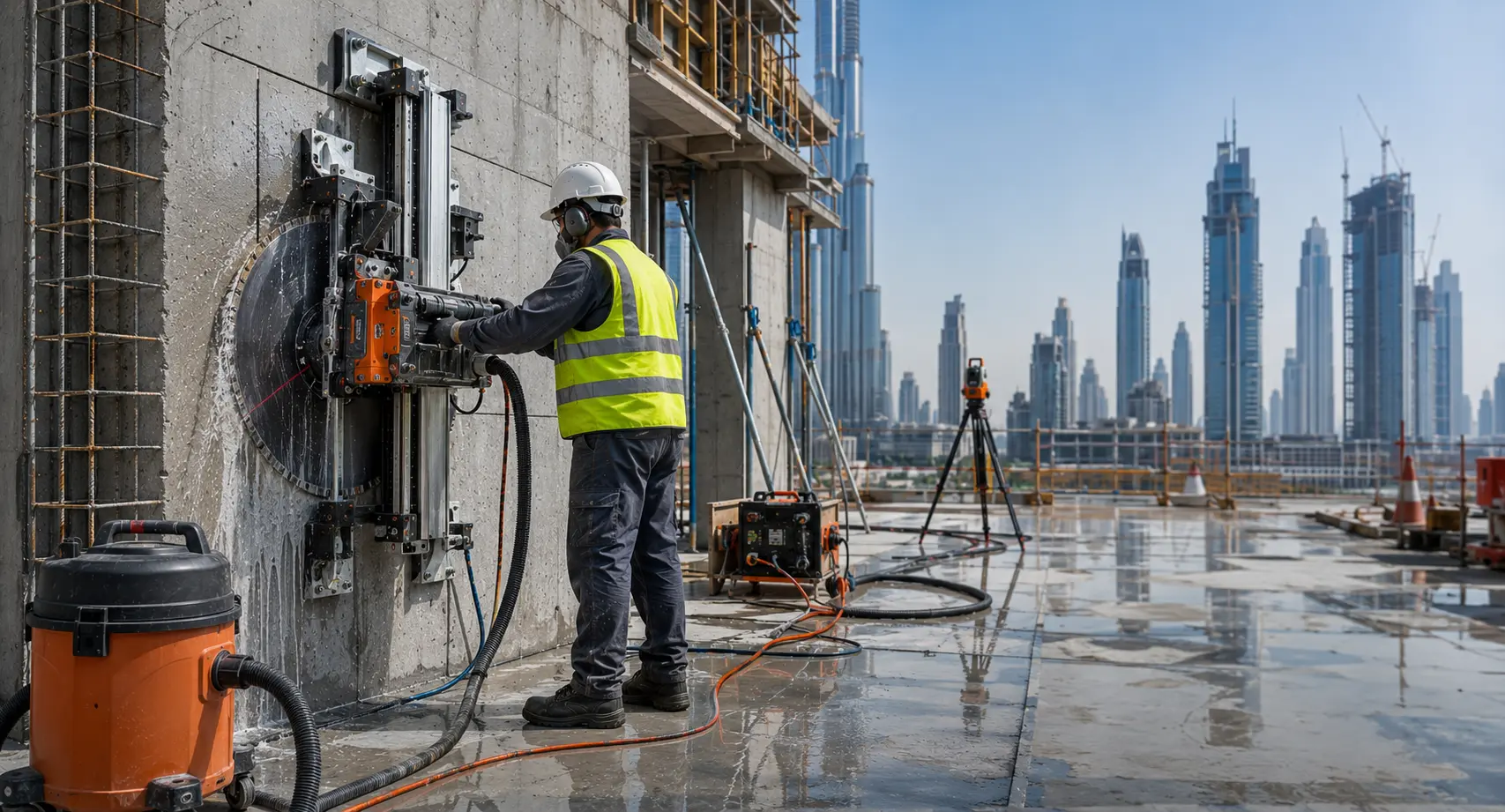
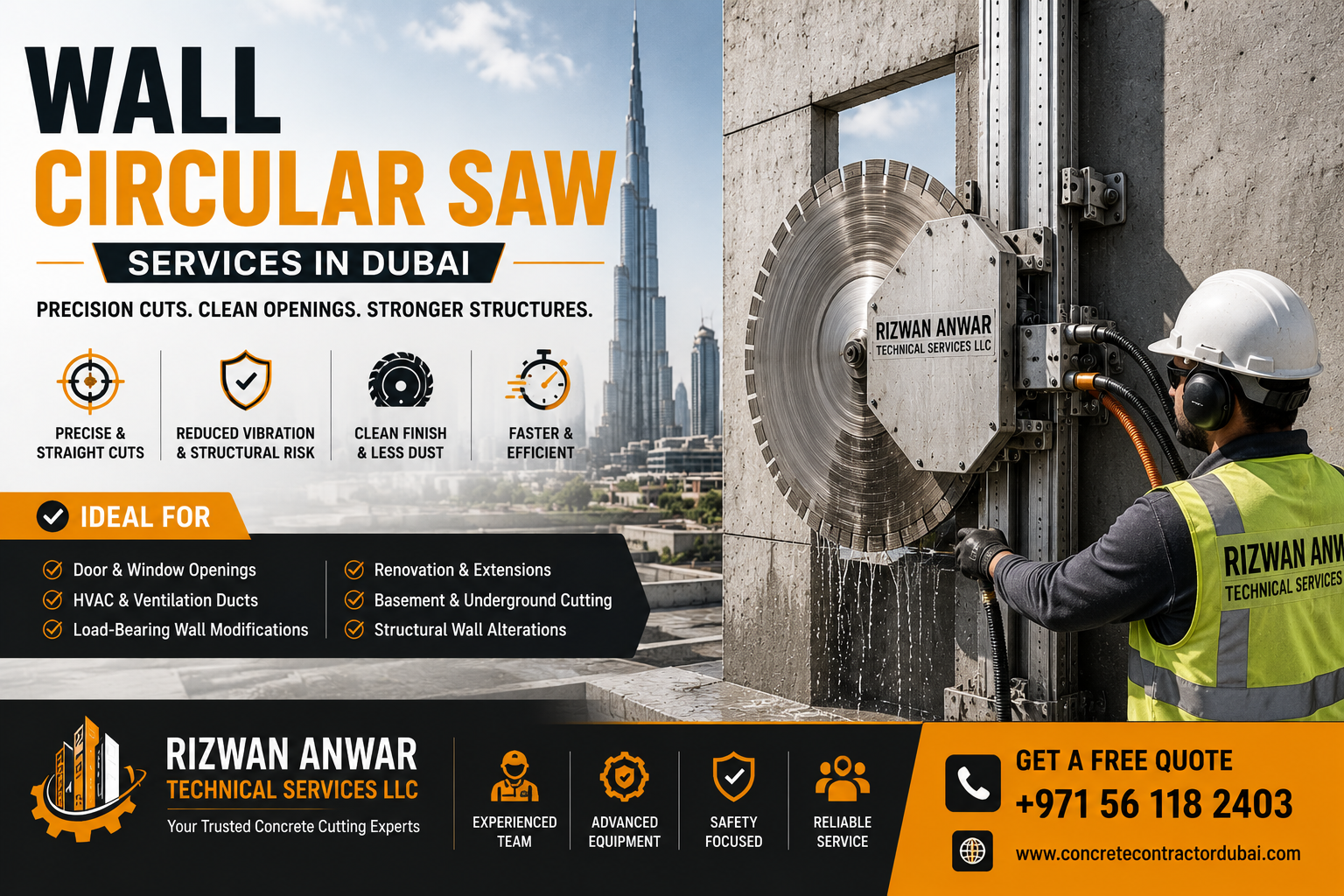
When it comes to cutting clean, precise openings in concrete walls, few tools match the accuracy and reliability of a wall circular saw. Whether the project calls for a new doorway, a window opening, or a structural modification, this equipment allows contractors to make controlled, straight cuts through even thick, reinforced concrete without the disruption caused by traditional demolition. At Rizwan Anwar Technical Services LLC, we provide professional wall circular saw services in Dubai for residential, commercial, and industrial projects. In this guide, we’ll explain what a wall circular saw is, how it works, where it’s commonly used, and why choosing the right contractor for this type of cutting makes a real difference in the outcome of your project. What Is a Wall Circular Saw? A wall circular saw is a track-mounted cutting machine that uses a large, rotating diamond blade to cut straight lines through concrete, masonry, and reinforced walls. The blade is mounted on a guide rail or track, which keeps the cut perfectly straight from start to finish, unlike handheld tools that rely entirely on the operator’s steadiness. This type of saw is powered by electric, hydraulic, or pneumatic motors, depending on the size of the job and the thickness of the concrete being cut. Because the blade runs along a fixed track, a wall circular saw can cut through walls up to 30 inches deep from one side, and even deeper when cutting from both sides of a wall. Select wall circular saw services are typically chosen over handheld cutting tools whenever a project requires deep, straight cuts — such as forming door openings, window frames, ventilation ducts, or larger structural modifications in load-bearing concrete walls. Why Wall Circular Saw Cutting Matters for Your Project Choosing the right cutting method for concrete walls isn’t just about convenience — it has a direct impact on safety, structural integrity, and the overall finish of the work. Here’s why this matters: 1. Deep, Precise Cuts A wall circular saw can cut through significantly thicker concrete than handheld tools, making it the preferred choice for structural walls, foundations, and heavily reinforced sections. 2. Straight, Consistent Lines Because the blade is guided along a fixed track, every cut follows an exact path, which is essential when preparing openings for doors, windows, or fitted structural elements. 3. Reduced Vibration and Structural Risk The controlled, track-guided motion of a wall circular saw produces far less vibration than jackhammers or handheld breakers, significantly lowering the risk of cracking in surrounding concrete. 4. Cleaner, Faster Results Compared to manual demolition, a wall circular saw completes cutting work in a fraction of the time while leaving a clean, finished edge that requires little to no additional preparation. Our Services in Dubai We offer a complete range of wall circular saw solutions tailored to different project requirements across Dubai and the wider UAE: Door and Window Opening Cuts Precise, straight-edged openings cut into concrete walls for new doors, windows, or architectural modifications. Structural Opening Preparation Clean, controlled cuts for HVAC ducts, ventilation shafts, elevator shafts, and other structural penetrations. Load-Bearing Wall Modifications Careful, calibrated cutting for structural changes in load-bearing walls, planned in coordination with structural assessments. Renovation and Extension Cutting Wall circular saw cutting for residential and commercial renovation projects requiring new openings or wall removal sections. Underground and Basement Wall Cutting Specialized cutting for basement walls and underground structures where dust control and vibration reduction are especially important. How the Wall Circular Saw Process Works Understanding what to expect from a wall circular saw contractor can help you plan your project more effectively: Site Assessment Our team inspects the wall to be cut, checking thickness, reinforcement, and the surrounding structure to determine the safest and most efficient cutting approach. Track Setup and Alignment The guide track for the wall circular saw is securely mounted and aligned along the planned cutting line, ensuring the blade follows an exact, straight path. Depth Calibration Cutting depth is calibrated based on wall thickness, allowing for either a full-depth cut or a controlled partial cut depending on project requirements. Cutting with the Machine The motorized saw moves along the track, cutting through the concrete with a diamond blade while maintaining consistent speed and pressure throughout. Dust and Water Management Water-fed or vacuum dust suppression systems are used throughout the cutting process to minimize airborne dust and keep the site clean and safe. Inspection and Finishing Once cutting is complete, the edges are inspected for straightness and finish quality before the opening is handed over for the next stage of construction. Where Wall Circular Saw Cutting Is Commonly Used Wall Circular Saw vs. Handheld Concrete Cutting While handheld tools are useful for smaller, more flexible tasks, a wall circular saw offers clear advantages for larger, more precise cutting work: Factor Wall Circular Saw Handheld Concrete Saw Cutting Depth Up to 30 inches (60 with two-sided cuts) Limited by blade size Cutting Line Accuracy Track-guided, perfectly straight Depends on operator skill Vibration Minimal, controlled motion Higher, freehand operation Best Suited For Large openings, structural walls Smaller openings, minor cuts Finish Quality Clean, uniform edge Can vary with technique For deep, structural cuts where precision and safety both matter, a wall circular saw consistently delivers a more reliable result than handheld alternatives. Equipment We Use Our team uses professional-grade wall circular saws fitted with high-performance diamond blades, precision guide tracks, and integrated dust or water suppression systems. This equipment allows us to handle everything from small residential openings to large-scale structural cutting projects, always with a strong focus on accuracy, safety, and site cleanliness. Factors That Affect Cutting Cost in Dubai Every project is different, and the cost of wall circular saw services typically depends on several factors: Wall Thickness Thicker or heavily reinforced walls require deeper cuts, more blade wear, and additional cutting time compared to standard walls. Total Length of Cutting Pricing is usually calculated based on the total linear length of the cut, so longer openings will affect the

Soft Cut Concrete Saw Services in Dubai | Early Entry Concrete Cutting

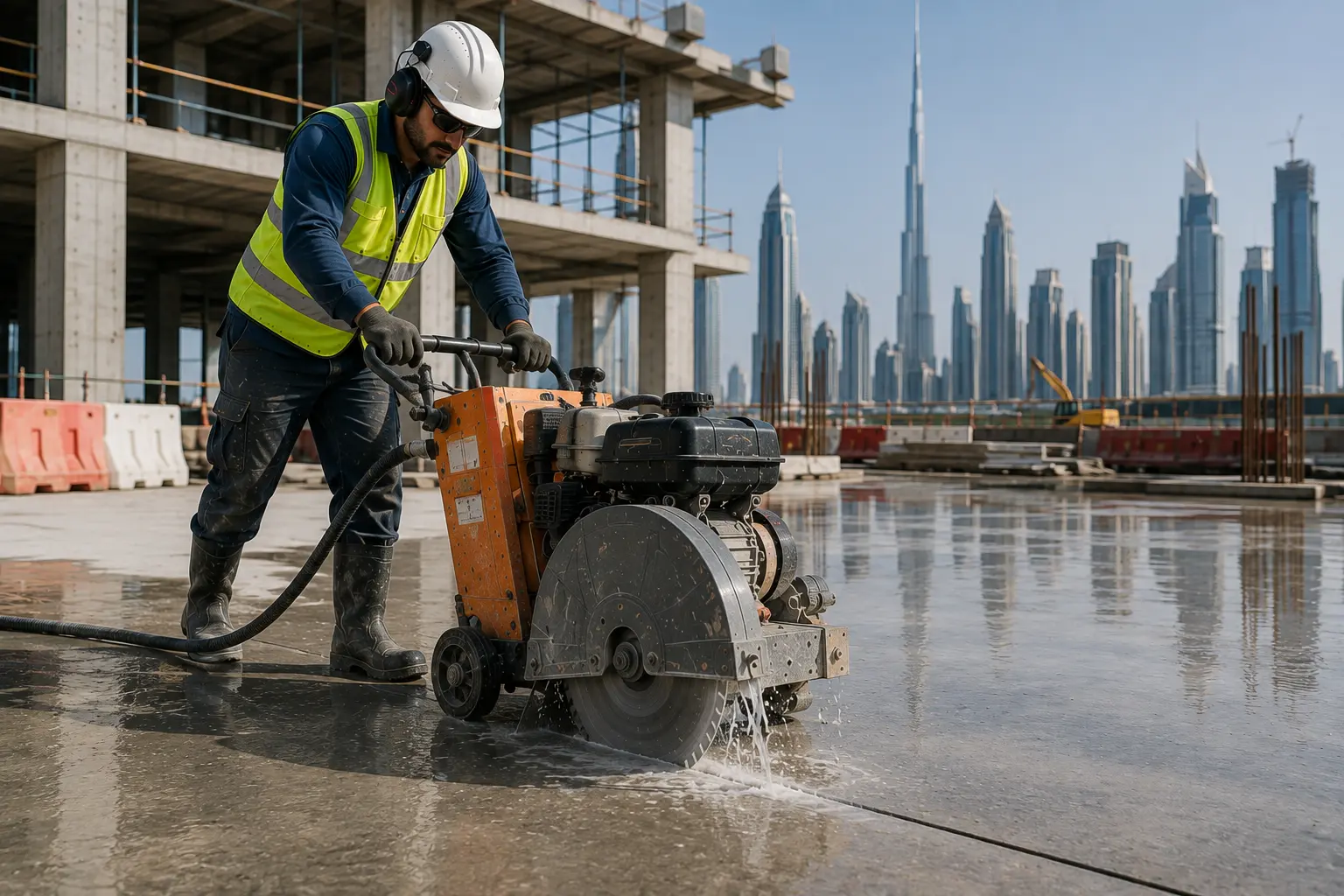
Soft Cut Concrete Saw Services in Dubai Timing is everything when it comes to cutting control joints in freshly poured concrete. Cut too early and the slab can ravel or crumble at the edges; cut too late and uncontrolled cracking may already have started. This is exactly the problem a soft cut concrete saw is designed to solve — allowing joints to be cut much earlier than traditional wet or dry sawing methods, right when the concrete is still relatively “green.” At Rizwan Anwar Technical Services LLC, we provide professional soft cut concrete saw services in Dubai for residential, commercial, and industrial concrete flooring projects. In this guide, we’ll explain what soft cut concrete saw cutting actually involves, how it differs from traditional saw cutting, when it should be used, and why timing this process correctly can save your project from costly cracking issues. What Is a Soft Cut Concrete Saw? A soft cut concrete saw is a lightweight, specialized saw used to cut control joints into concrete slabs shortly after they are poured — typically within one to four hours, depending on weather conditions and the concrete mix design. Unlike conventional saws that require the concrete to cure for a full day or more, a soft cut concrete saw is engineered with a skid plate and a specially designed blade that allows cutting on concrete that is still in its early, “green” state. The term “soft cut” refers to the timing of the cut rather than the hardness of the blade — the concrete itself is still relatively soft when the cut is made. This early-entry approach is also sometimes called green concrete cutting or early entry sawing, and it has become a standard practice on large concrete flooring projects where crack control is critical. Select soft cut concrete saw services are typically chosen over traditional wet sawing when a project has a tight schedule, a large slab area, or a high risk of random shrinkage cracking that needs to be controlled early. Why Soft Cut Concrete Saw Cutting Matters Choosing the right timing and method for joint cutting isn’t just a technical preference — it has a direct impact on the long-term durability and appearance of a concrete floor. Here’s why a soft cut concrete saw makes such a difference: 1. Reduces the Risk of Random Cracking Concrete begins to shrink as it cures, and if control joints aren’t cut early enough, the slab may crack randomly in uncontrolled locations. Cutting with a soft-cut concrete saw within the first few hours allows joints to form before random cracks have a chance to develop. 2. Faster Project Turnaround Because a soft cut concrete saw can be used so early, crews can move through large flooring areas much faster than waiting for concrete to fully cure before traditional sawing begins. 3. Cleaner, More Consistent Joints The specially designed skid plate and blade depth control on a soft cut concrete saw produce clean, straight joints without excessive raveling or chipping along the edges, even on freshly placed concrete. 4. Lower Labor and Scheduling Costs Early-entry cutting means joint-cutting crews can complete their work sooner, which helps keep tight construction schedules on track without waiting for extended curing periods. Our Soft Cut Concrete Saw Services in Dubai We offer a complete range of soft cut concrete saw solutions tailored to different flooring and slab projects across Dubai and the wider UAE: Early Entry Control Joint Cutting Precise control joints cut within hours of concrete placement to manage shrinkage cracking before it starts. Warehouse and Industrial Floor Slab Cutting Large-format soft cut sawing for warehouse floors, distribution centers, and industrial facilities where crack control across large slab areas is essential. Residential and Commercial Driveway Joints Clean, early-cut control joints for driveways, parking areas, and pathways to prevent unsightly random cracking. Parking Structure Slab Cutting Soft cut joint cutting for multi-level parking structures, where large open slabs are especially prone to shrinkage-related cracking. Warehouse Floor Renovation Support Soft cut sawing used alongside new floor pours during renovation and expansion projects to maintain consistent joint patterns. How the Soft Cut Concrete Saw Process Works Understanding what to expect from a soft cut concrete saw contractor can help you plan your concrete pour schedule more effectively: Pre-Pour Planning Our team reviews the slab layout and joint spacing plan in advance, coordinating timing with the concrete pouring crew to ensure cutting can begin at the right moment. Monitoring Concrete Set Time Once the concrete is poured, our technicians closely monitor the surface hardness and weather conditions, since temperature and humidity directly affect how soon a soft cut concrete saw can be used. Early-Entry Cutting Using a lightweight soft cut concrete saw fitted with a skid plate, our team cuts control joints to the specified depth, typically within one to four hours after the pour. Depth and Spacing Verification Each joint is checked against the project’s joint spacing and depth requirements to ensure proper crack control across the entire slab. Joint Cleaning Once cutting is complete, joints are cleaned of any residue or debris to prepare the surface for the next stage of finishing or sealing. Final Inspection Our team performs a final walk-through to confirm all control joints meet the required pattern, depth, and spacing before handover. Where Soft Cut Concrete Saw Cutting Is Commonly Used Soft Cut Concrete Saw vs. Traditional Wet Saw Cutting Many contractors still wait for concrete to fully cure before cutting joints, but this comes with real drawbacks compared to using a soft cut concrete saw at the right time: Factor Soft Cut Concrete Saw Traditional Wet Saw Cutting Timing 1–4 hours after pour 12–24+ hours after pour Crack Control Excellent, cuts before shrinkage cracking Higher risk if delayed Equipment Weight Lightweight, skid-plate design Heavier, requires cured surface Water Requirement Typically dry cutting Requires water for blade cooling Project Timeline Impact Speeds up schedule Can delay subsequent work Joint Edge Quality Clean with proper technique Can be clean, but timing-dependent For

Vertical Panel Saw Cutting Services in Dubai | Precision Concrete Panel Cutting

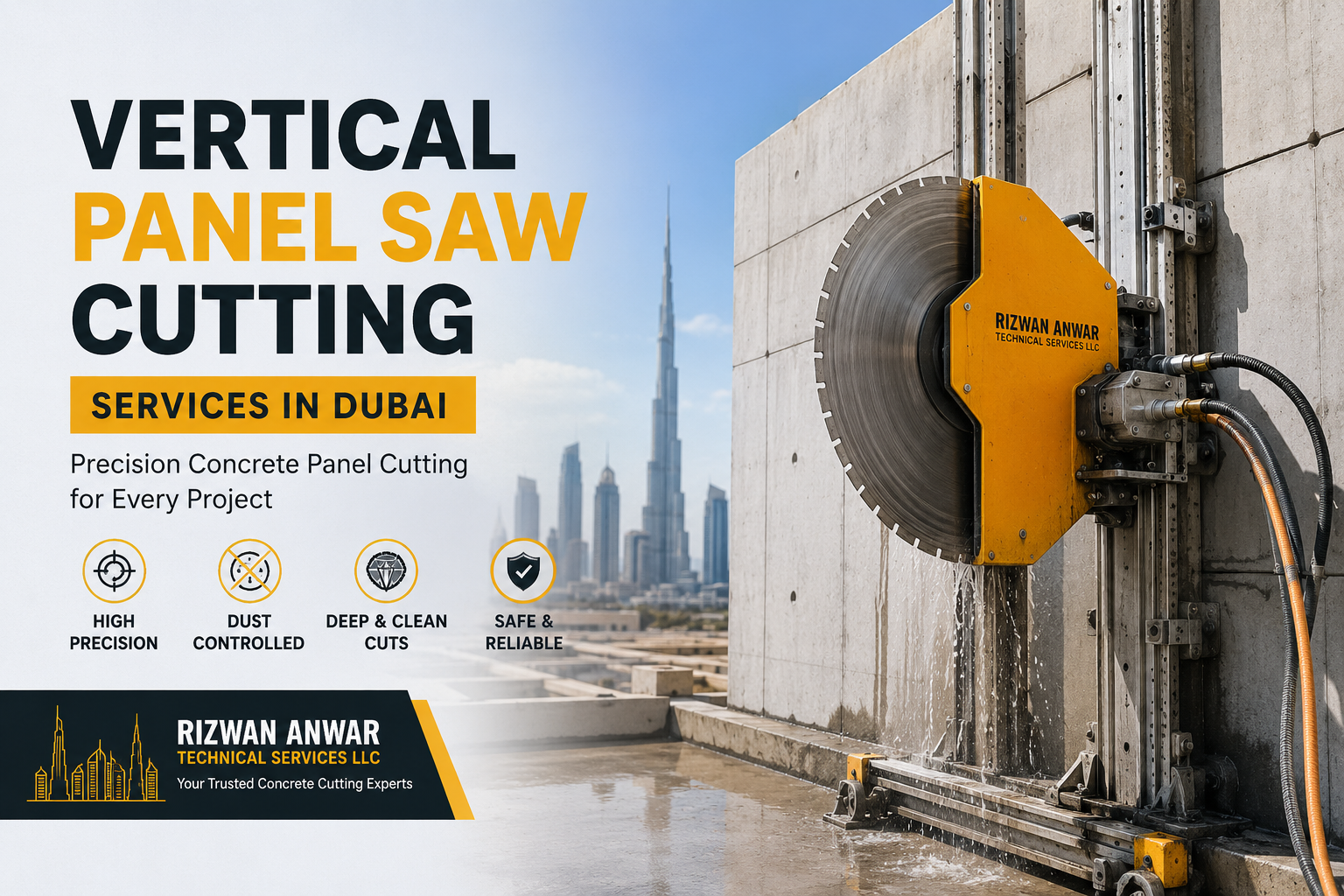
Vertical Panel Saw Cutting Services in Dubai Construction and remodeling works in Dubai nowadays require precision cuts to be made in huge concrete panels, precast walls, and vertical structures. This is where vertical panel saw cutting becomes useful. While handheld equipment requires manual control, a vertical panel saw is attached to a stationary frame, which moves vertically and horizontally over the wall or panel, providing perfectly straight cut lines each time. Our company, Rizwan Anwar Technical Services LLC, offers vertical panel saw cutting services in Dubai for both residential and commercial projects. In this article, we will tell you what vertical panel saw cutting means, how it differs from other concrete cutting techniques, where it is most frequently applied, and why it is important to choose the right contractor. What Is Vertical Panel Saw Cutting? Vertical panel saw cutting is a precision concrete cutting method that employs a track-guided, powered saw machine to cut straight vertical or horizontal lines on concrete panels, walls, and slabs. The saw machine is attached to a track or frame that guides the diamond blade along a precise line for deep cuts without any deviation. This method comes in handy when dealing with huge precast concrete panels, tilt-up wall segments, or vertical structures of considerable thicknesses that are difficult to cut using handheld saws and would require accurate cuts. Since the blade is guided by a machine and not hand-held, this method results in a more precise edge, less chances of cracking, and deeper cuts. Vertical panel saw cutting is preferred to other methods when the work at hand involves long and straight cuts, such as sectioning precast panels, making expansion joints, or opening up tilt-up concrete walls. Why Vertical Panel Saw Cutting Matters for Your Project Selecting the appropriate method of cutting the big concrete slab is not just a matter of convenience but has a lot to do with its structural stability, safety, and the general outcome of the entire project. The reason why this is important is that 1. Exceptional Precision on Large Surfaces The reason for that is the track upon which the saw is moving is stationary, therefore every cut is along the same line all the way through, and that is very important while working with big precast slabs. 2. Deeper, Cleaner Cuts The vertical panel saws can cut through much thicker portions of concrete than many of the handheld saws and thus are best suited for cutting through structural panels, load-bearing walls, and very heavy precast units. 3. Reduced Risk of Cracking or Chipping The steady movement of the blade makes sure there is minimal vibration or irregular pressure on the blade, thus ensuring that the risk of any cracks or chips occurring in the cut is greatly minimized. 4. Faster Turnaround on Large Jobs If there is an ongoing project that requires cutting through multiple panels, the vertical panel saw is the better option to choose due to its increased efficiency. Our Vertical Panel Saw Cutting Services in Dubai We offer a complete range of vertical panel saw cutting services in Dubai, tailored to different project requirements across Dubai and the wider UAE: Precast Concrete Panel Cutting Precise sectioning and trimming of precast concrete panels used in modern building facades, boundary walls, and modular construction. Tilt-Up Wall Cutting Accurate vertical cuts in tilt-up concrete wall panels, commonly used in warehouses, industrial facilities, and large commercial developments. Expansion Joint Cutting Straight, evenly spaced joint cuts to accommodate concrete expansion and contraction, helping prevent unwanted cracking over time. Structural Opening Preparation Clean vertical cuts to prepare openings for doors, windows, or service penetrations in large concrete wall sections. Slab and Wall Division Cutting Dividing large concrete slabs or wall sections into smaller, more manageable pieces for renovation, demolition, or removal. How the Vertical Panel Saw Cutting Process Works Knowing what to expect from a vertical panel saw cutting contractor can help you plan your project more effectively. Here’s how the process typically unfolds: Site Assessment Our team inspects the panel or wall to be cut, checking thickness, reinforcement, and the surrounding structure to determine the safest and most efficient cutting approach. Track Setup and Alignment The saw’s guide track is securely mounted and aligned along the planned cutting line, ensuring the blade will follow an exact, straight path from start to finish. Depth Calibration The cutting depth is calibrated based on the panel or wall thickness, allowing for either a full-depth cut or a controlled partial cut depending on project requirements. Vertical Panel Saw Cutting Services in Dubai Cutting with the Vertical Panel Saw The motorized saw moves smoothly along the track, cutting through the concrete with a diamond blade while maintaining consistent speed and pressure throughout the cut. Dust and Debris Control Water-fed or vacuum dust suppression systems are used throughout the cutting process to minimize airborne dust and keep the surrounding area clean and safe. Inspection and Finishing Once cutting is complete, the edges are inspected for straightness and finish quality before the section is handed over for the next stage of construction or removal. Where Vertical Panel Saw Cutting Is Commonly Used Precast concrete works — cutting of panels to specific measurements Building and warehouse constructions — cutting of wall panels while erecting Commercial development works—forming openings in large concrete walls Demolition and renovation works — sectioning of walls or concrete slabs Infrastructure construction works — making of expansion joints in concrete structures Vertical Panel Saw Cutting vs. Handheld Wall Saw Cutting While handheld wall saws are useful for smaller, more flexible cutting tasks, vertical panel saw cutting offers clear advantages for large-scale, high-precision work: Factor Vertical Panel Saw Cutting Handheld Wall Saw Cutting Line Accuracy Track-guided, perfectly straight Depends on operator skill Maximum Cutting Depth Deeper cuts on thick panels Limited by blade and tool size Best Suited For Large panels, precast, tilt-up walls Smaller openings, doors, windows Vibration Control Minimal, smooth guided motion Higher, freehand operation Finish Quality Clean, uniform edge Can vary

Concrete Chasing Saw Services in Dubai | Professional Wall & Slab Chasing Contractors

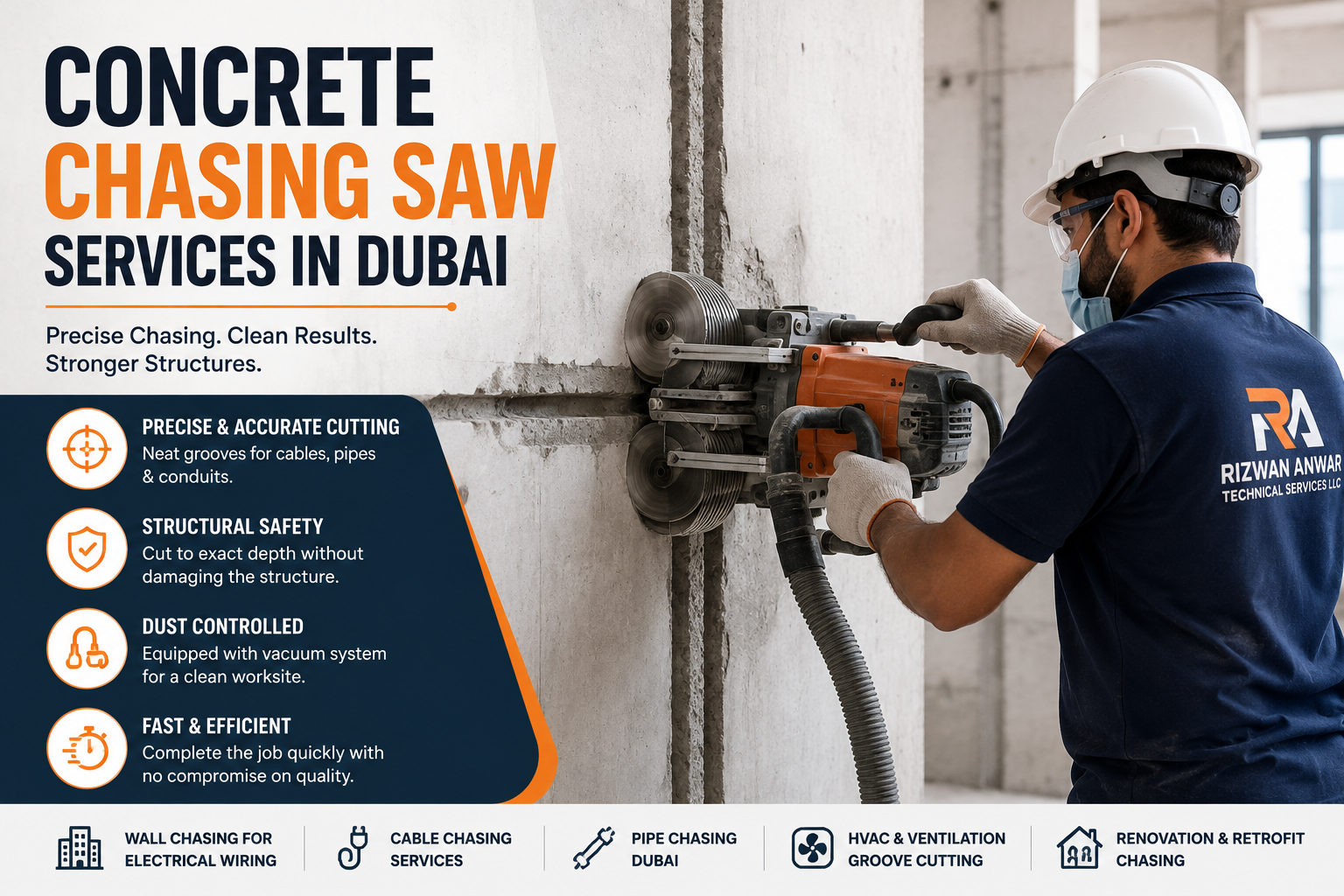
Concrete Chasing Saw Services in Dubai When it comes to construction and renovation projects in the UAE being accurate is just as important as working quickly. One service that often gets ignored. Until its really needed. Is chasing. Whether you’re putting in wires running water pipes or getting walls ready for electrical lines a professional concrete chasing saw is the tool that helps make neat exact cuts without hurting the rest of the building. At Rizwan Anwar Technical Services LLC we offer reliable concrete chasing saw services in Dubai for homes, businesses and factories. In this guide we’ll explain what concrete chasing really means, why it’s important, for buildings how the work is done and why picking the right chasing contractor can help you save time, money and avoid damaging the structure. What Is Concrete Chasing? Concrete chasing is the act of making an controlled groove into a concrete or masonry wall, floor or ceiling. This groove is called a “concrete chasing saw” These grooves are usually used to hide wiring, plumbing pipes, data cables or ventilation lines under a flat finished surface. Unlike hitting with a hammer or using manual chiseling a concrete chasing saw has two diamond blades attached to a track. This helps the person using it to make two lines at the same depth and width. Then the material between the lines is taken out cleanly. The end result is a even channel that can be filled and covered with plaster without any visible signs. This is a different method compared to core cutting or wall sawing which are often used for bigger openings like doors, windows or air shafts. Chasing is about accuracy, in a small way. Narrow, shallow and carefully made cuts that keep the wall strong and safe. Why Select Concrete Chasing Saw Services Matter Choosing the right method and the right team for chasing work is not just a matter of convenience—it directly affects the safety and lifespan of a building. Here’s why it’s worth being selective: 1. Structural Safety An improperly cut chase can weaken load-bearing walls or damage embedded reinforcement bars. A calibrated chasing machine cuts to an exact, pre-set depth, avoiding the guesswork that comes with manual tools. 2. Clean, Dust-Controlled Cutting Professional chainsaws are usually paired with vacuum dust extraction systems. This keeps the worksite clean and significantly reduces airborne concrete dust—an important factor for occupied buildings, hospitals, offices, and residential units. 3. Speed Without Compromise A guided chasing saw completes in minutes what would take hours using a hammer and chisel, without sacrificing accuracy. 4. Long-Term Cost Savings Poor chasing work often leads to cracking, uneven plastering, or the need for rework. Getting it right the first time avoids these hidden costs. Our Concrete Chasing Saw Services in Dubai We offer a full range of chasing solutions tailored to different project needs across Dubai and the wider UAE: Wall Chasing for Electrical Wiring Precise horizontal and vertical grooves for concealing electrical conduits and wiring, cut to match standard cable and pipe diameters. Cable Chasing Services Dedicated channels for low-voltage cabling, networking lines, security systems, and data infrastructure — ideal for offices, villas, and commercial fit-outs. Pipe Chasing Dubai Deeper, wider grooves designed to house plumbing pipes and drainage lines within walls or floors, cut with attention to slope and alignment requirements. Groove Cutting for HVAC and Ventilation Controlled channels for smaller ducting and ventilation lines in walls where surface-mounted fittings aren’t practical or aesthetically desirable. Renovation and Retrofit Chasing For older buildings undergoing electrical or plumbing upgrades, we carry out chasing work with minimal disruption to existing finishes and occupants. How the Concrete Chasing Process Works When you hire a chasing contractor it is an idea to know what they will do. Here is what you can expect from the chasing contractor: Site Assessment The team from the chasing contractor will look at the wall or floor. They will check if there are any pipes or wires in the wall. They will also check how deep and wide the chase needs to be. Marking and Planning The chasing contractor will draw lines on the wall. These lines will show where the pipes or wires will go. They will make sure these lines are straight and match up with the switches and sockets. Cutting with the Chasing Machine The chasing contractor will use a machine to cut the wall. This machine has two diamond blades that cut two lines in the wall. The lines are cut at the depth and are straight. Material Removal The chasing contractor will remove the concrete, between the two lines. They will use a tool to break up the concrete and then vacuum it up. Dust Extraction The chasing contractor will use a vacuum to clean up the dust. This keeps the air clean and safe to breathe. Handover The chasing contractor will check the chase to make sure it is okay. They will check that it is the depth and straight. Then they will give it to the electrician or plumber to finish the job. The chasing contractor will make sure the chase is clean before they hand it over. Where Concrete Chasing Is Commonly Used Residential villas and apartments — concealing wiring and plumbing during fit-out or renovation Commercial offices — network cabling, security systems, and lighting circuits Retail fit-outs — flush-mounted electrical points for a clean visual finish Industrial facilities — routing pipework and cabling through concrete or block walls Hospitals and clinics — low-dust, low-disruption chasing for sensitive environments Concrete Chasing Saw vs. Manual Chiseling Many contractors still rely on hand tools for chasing work, but this comes with real drawbacks compared to using a proper chasing saw: Factor Concrete Chasing Saw Manual Chiseling Precision Exact depth and width Inconsistent, uneven Speed Fast, guided cutting Slow, labor-intensive Wall Damage Risk Minimal, controlled Higher risk of cracking Dust Control Vacuum-extracted Uncontrolled dust Finish Quality Clean, uniform groove Rough, irregular edges For any project where finish quality and structural safety

Electric Wall Cutter Service

Electric Wall Cutter Service in Dubai for Precise Concrete Cutting Concrete walls provide strength, stability, and long term durability to buildings, but modifying an existing concrete wall can be a challenging task. When a new doorway, window, ventilation opening, electrical route, or mechanical passage is required, using ordinary cutting tools may not provide the accuracy and control needed for professional construction work. An Electric Wall Cutter Service provides a practical solution for controlled cutting through concrete and other hard construction materials. Electric wall cutting equipment is designed to use a powerful motor and diamond cutting blade to create straight, accurate cuts through walls and vertical structures. Concrete Contractor Dubai provides professional concrete cutting services across Dubai, including wall saw cutting, core cutting, slab cutting, roof cutting, wire saw cutting, and demolition. Its wall saw service is designed for accurate cutting of concrete walls and vertical structures for applications such as doors, windows, ducts, and structural openings. What Is an Electric Wall Cutter? An electric wall cutter is specialized equipment designed to cut concrete walls using a rotating diamond blade powered by an electric motor. The machine provides controlled cutting along a predetermined line. Depending on the equipment and project requirements, the cutting system may be mounted on a guide track or operated using another controlled configuration. The diamond blade is the main cutting component. Unlike ordinary construction blades, diamond blades are manufactured with industrial diamond segments that are designed to cut hard materials such as: The exact equipment and blade selection depends on the material, wall thickness, cutting depth, and required opening. What Is an Electric Wall Cutter Service? An Electric Wall Cutter Service involves professional technicians using specialized electric wall cutting equipment to create controlled cuts in concrete structures. The service can be used for different construction and renovation requirements. Common applications include: The main objective is to remove only the required section of concrete while maintaining control over the cutting operation. This makes professional wall cutting different from uncontrolled breaking or demolition. Why Electric Wall Cutting Is Used in Dubai Dubai has a large number of residential, commercial, industrial, and infrastructure projects. Many existing buildings are renovated or modified to accommodate new layouts and modern building services. For example, an office may require a new doorway between two rooms. A villa may require a new window opening. A commercial property may need an opening for an HVAC duct. A warehouse may require a new service passage through a concrete wall. In these situations, precise cutting is often more practical than breaking the concrete with heavy impact tools. Professional wall cutting equipment can create defined cutting lines and allow the required concrete section to be removed in a controlled manner. How an Electric Wall Cutter Works The wall cutting process normally begins with an assessment of the work area. The technician first identifies the location and dimensions of the required opening. The wall is then examined to understand its thickness, condition, reinforcement, accessibility, and surrounding environment. The required cutting lines are marked on the wall. If the project requires it, concrete scanning or other detection methods can be used to identify concealed elements before cutting. The cutting equipment is then positioned. A diamond blade suitable for the concrete and cutting requirements is selected. The blade begins rotating and gradually penetrates the concrete. The operator controls the cutting movement along the planned line. For larger openings, several cuts may be required. After the cuts are completed, the concrete section can be divided into manageable pieces and removed using an appropriate method. The final opening is then inspected and prepared for the next stage of construction. Main Components of an Electric Wall Cutter A professional wall cutting system consists of several important components. Electric Motor The motor provides the power required to rotate the diamond blade. The motor capacity should be appropriate for the cutting requirements. Diamond Blade The diamond blade performs the actual cutting. Blade selection depends on the concrete type, reinforcement, required depth, and other project conditions. Guide System Many professional wall saw systems use a guide track. The guide helps the cutting unit move along a predetermined path. This can improve straightness and overall cutting accuracy. Mounting System The equipment needs to be securely positioned before cutting begins. A stable mounting system helps reduce unwanted movement during operation. Water Supply Wet cutting systems may use a controlled water supply during cutting. Water can help cool the blade and control concrete dust. Safety Controls Professional equipment includes controls that allow the operator to manage the cutting operation. Proper equipment handling and operator training remain essential. Benefits of Electric Wall Cutter Service Professional wall cutting provides several advantages over uncontrolled concrete breaking. Accurate Cutting One of the biggest advantages is precision. The operator can follow predetermined cutting lines to create an opening according to the required dimensions. This is particularly important for doors, windows, HVAC openings, and other installations. Controlled Operation Electric wall cutting allows the operator to control the cutting process rather than simply breaking the concrete. This can help reduce unnecessary damage around the intended opening. Clean Straight Cuts Diamond cutting technology can produce relatively smooth and straight cutting lines when the equipment is properly installed and operated. Suitable for Renovation Existing buildings often require modifications. Wall cutting can help contractors create new openings without demolishing a larger section of the wall. Suitable for Reinforced Concrete Appropriate diamond cutting equipment can be used for reinforced concrete applications. However, reinforcement location and structural requirements should be assessed before cutting. Reduced Unnecessary Impact Compared with heavy impact demolition, controlled diamond cutting can reduce unnecessary vibration and uncontrolled breaking around the cutting area. Electric Wall Cutter for Door Openings Door openings are one of the common applications for professional wall cutting. A renovation project may require a new doorway between two rooms. The required width and height are established first. The cutting lines are then marked accurately. Before cutting, the wall should be assessed for reinforcement and concealed services. Once

Core Cutting Company in Dubai

Core Cutting Company in Dubai Professional Concrete Cutting Services Concrete is one of the most widely used construction materials in Dubai because of its strength, durability, and ability to support demanding structures. However, construction and renovation projects often require precise openings through existing concrete walls, floors, slabs, ceilings, and other structural elements. Choosing the right Core Cutting Company in Dubai is therefore an important decision for contractors, engineers, property developers, facility managers, and homeowners. The quality of the cutting work can directly affect the next stage of construction, whether the opening is required for plumbing, electrical systems, HVAC installations, drainage, ventilation, or structural modifications. A professional concrete cutting contractor should have suitable equipment, trained technicians, practical site experience, and a clear understanding of concrete structures. Concrete Contractor Dubai provides professional concrete cutting solutions across Dubai, including core cutting, wall saw cutting, slab cutting, roof cutting, wire saw cutting, and demolition. Its core cutting service is designed to create precise circular openings in concrete walls, slabs, and floors for residential, commercial, and industrial projects. What Is Concrete Core Cutting? Concrete core cutting is a specialized drilling process used to create circular openings through concrete structures. Instead of breaking the concrete around the required area, a cylindrical section is drilled and removed using a diamond core bit. The resulting hole can then be used for different construction services. Common applications include: Core drilling is particularly useful when a project requires a clean circular opening. The diameter of the opening can be selected according to the installation requirements. For example, a small opening may be sufficient for an electrical conduit, while a larger diameter may be required for a drainage pipe or mechanical system. Why Hire a Professional Core Cutting Company in Dubai? Concrete cutting may appear simple from the outside, but professional core drilling requires appropriate equipment, accurate measurements, and experienced operation. Hiring a professional contractor provides several advantages. Accurate Hole Dimensions Professional core drilling equipment is designed to create controlled circular openings. This is important when the hole needs to match the exact diameter of a pipe, cable sleeve, duct, or mechanical component. Reduced Structural Disturbance Controlled diamond drilling removes a specific cylindrical section rather than breaking a large surrounding area. This can help reduce unnecessary disturbance to the concrete. Suitable for Reinforced Concrete Many modern structures contain steel reinforcement. Professional diamond core drilling equipment can be selected according to the concrete condition and reinforcement requirements. Better Project Efficiency Experienced technicians understand how to set up the equipment and perform the drilling operation efficiently. This can help reduce delays on construction and renovation projects. Improved Safety Professional operators understand equipment handling, work area control, water management, and concrete debris management. These factors are important when drilling inside occupied buildings or active construction sites. How Does Concrete Core Cutting Work? A professional core cutting project normally follows a structured process. Site Inspection The first step is to inspect the location where the opening is required. The technician evaluates: This information helps determine the appropriate drilling method. Marking the Drilling Location The exact center point of the required hole is marked on the concrete surface. Accurate marking is important because even a small positioning error can affect pipe, cable, or duct installation. Checking for Concealed Services Existing concrete structures may contain electrical cables, pipes, reinforcement, or other embedded elements. Where appropriate, scanning or detection should be considered before drilling. This is especially important in existing buildings where original construction information may not be available. Equipment Setup The core drilling machine is positioned at the required location. Depending on the application, the equipment may be securely anchored to the concrete surface. Correct alignment is important for maintaining the required drilling direction. Diamond Core Drilling The diamond core bit begins rotating and gradually penetrates the concrete. Water may be used during the drilling process to cool the diamond segments and control dust. The operator monitors the drilling operation and adjusts the process according to the concrete conditions. Core Removal Once the drilling reaches the required depth, the cylindrical concrete core is removed. The opening is then inspected to confirm that it matches the project requirements. What Is a Diamond Core Bit? A diamond core bit is a cylindrical cutting tool designed for drilling holes through hard construction materials. Its cutting edge contains industrial diamond segments. As the bit rotates, these segments gradually grind through concrete. Diamond core bits are available in different diameters and specifications. The correct bit depends on: Selecting the correct core bit can improve drilling efficiency and help maintain consistent results. Main Applications of Core Cutting in Dubai A professional Core Cutting Company in Dubai can support many construction and renovation applications. Plumbing Pipe Openings Plumbing installations often require pipes to pass through concrete walls, floors, and slabs. Core drilling can create circular openings for: The hole diameter should be selected according to the pipe and sleeve dimensions. Accurate positioning is equally important because the opening needs to align with the planned plumbing route. HVAC Installations Dubai buildings depend heavily on air conditioning and ventilation systems. HVAC installations frequently require openings through concrete structures. Core drilling can create circular penetrations for: Larger rectangular duct openings may require wall sawing rather than core drilling. The appropriate method depends on the shape and dimensions of the required opening. Electrical Cable Penetrations Electrical systems often require cables and conduits to pass through concrete walls or floors. Core drilling can provide controlled circular openings for conduit systems. Before drilling, existing electrical services should be identified wherever possible. This can reduce the risk of damaging concealed installations. Drainage Systems Drainage pipes frequently need to pass through concrete floors, slabs, and walls. Core drilling can provide the required circular opening while maintaining control over the surrounding concrete. The hole should be positioned according to the drainage design and required pipe slope. Ventilation Systems Commercial and industrial buildings may require ventilation openings. Depending on the system design, core drilling can be used for smaller circular penetrations and service

Wall Circular Saw

Wall Circular Saw in Dubai Precise Concrete Wall Cutting Concrete walls are built to provide strength, stability, and long term durability. However, construction and renovation projects often require these strong structures to be modified. New doors, windows, ventilation systems, electrical routes, plumbing lines, and other building services may require precise openings through existing concrete walls. A professional Wall Circular Saw provides an effective solution when accuracy and controlled cutting are important. Unlike basic demolition tools that break concrete through repeated impact, professional wall cutting equipment uses a rotating diamond blade to create controlled cuts along a planned line. Concrete Contractor Dubai provides professional concrete cutting solutions including wall saw cutting, core cutting, slab cutting, roof cutting, wire saw cutting, and demolition. Its wall saw cutting service is designed for concrete walls and vertical structures, with applications including doors, windows, ducts, and structural openings. What Is a Wall Circular Saw? A Wall Circular Saw is a specialized concrete cutting system designed to make controlled cuts through vertical surfaces. The equipment uses a circular diamond blade that rotates at high speed and gradually penetrates the concrete. Depending on the project, the saw can be mounted to a secure track or another suitable support system. The controlled movement of the saw allows the operator to follow a predetermined cutting path. This makes the equipment suitable for applications such as: The size and type of blade are selected according to the material, wall thickness, required cutting depth, and project requirements. How Does a Wall Circular Saw Work? The wall cutting process begins with careful planning. Before equipment is operated, the required opening is measured and marked on the concrete wall. The technician then evaluates the wall thickness and surrounding area. If the wall contains reinforcement or concealed services, additional inspection may be necessary. After the cutting area has been confirmed, the wall saw equipment is positioned securely. The circular diamond blade is then introduced into the concrete and gradually follows the marked cutting line. The operator controls the cutting speed and movement throughout the process. This controlled approach allows the technician to create straight cuts without unnecessarily disturbing areas outside the planned opening. For larger openings, the concrete may be divided into several sections. These sections can then be removed individually rather than attempting to remove one extremely heavy piece. Why Diamond Blades Are Used for Concrete Walls Concrete is a hard construction material, and reinforced concrete can be even more demanding because steel reinforcement is embedded inside it. Diamond blades are widely used for professional concrete cutting because they are designed for hard materials. A suitable diamond blade can provide: The exact blade specification should be selected according to the concrete condition and cutting requirements. Using the correct blade is particularly important when working with thick or heavily reinforced walls. Main Applications of a Wall Circular Saw A professional Wall Circular Saw can be used for many construction and renovation applications. The most suitable application depends on the required opening shape, size, depth, wall material, and project conditions. Door Opening Cutting Creating a new doorway is one of the most common reasons for modifying an existing concrete wall. During a renovation, the building layout may need to be changed to provide access between two rooms or areas. A professional wall saw can create controlled cuts around the planned doorway. The process normally involves: For structural walls, engineering approval should be obtained before cutting. Window Opening Cutting Existing buildings may require new or larger windows for natural light, ventilation, or architectural changes. A Wall Circular Saw can create controlled straight cuts around the required opening. The dimensions should be confirmed according to the window frame and installation requirements. Precise measurements are important because an opening that is too large or incorrectly positioned can create additional construction work. HVAC Duct Openings Heating, ventilation, and air conditioning systems often require openings through concrete walls. A new HVAC installation may require a rectangular or specially shaped opening for a duct or ventilation component. Professional wall cutting can create the required opening according to the dimensions provided by the HVAC contractor. Before cutting, the technician should confirm: Concrete Contractor Dubai specifically lists wall saw cutting for ducts among its applications. Ventilation Openings Commercial and industrial properties frequently need ventilation systems. Ventilation openings may be required in: A professional cutting system can create controlled openings through concrete walls for ventilation equipment. The opening dimensions should be established before cutting begins. Plumbing Service Openings Concrete walls may need openings for plumbing pipes during construction or renovation. Applications can include: For smaller circular penetrations, core drilling may be more suitable than wall sawing. The appropriate cutting method depends on whether the project requires a circular hole, straight cut, rectangular opening, or larger wall section removal. Electrical Service Openings Electrical systems can require conduits and cables to pass through concrete walls. A controlled wall cutting process can help create suitable routes or openings for these services. Before cutting, existing electrical installations should be identified wherever possible. This is especially important when modifying older buildings where construction drawings may not accurately represent existing services. Structural Wall Modifications Some projects require modifications to structural concrete walls. These may involve: Structural walls should always be treated differently from ordinary partitions. A structural wall can contribute to the stability and load carrying capacity of a building. Before removing any section, the proposed modification should be assessed according to the project’s engineering requirements. Wall Circular Saw Equipment Different projects require different cutting equipment. A professional contractor should select equipment according to the wall material, thickness, opening dimensions, and required depth. Track Mounted Wall Saw A track mounted wall saw uses a guide track secured to the wall. The saw moves along the track while the diamond blade cuts the concrete. This arrangement can provide excellent control and is useful when straight and accurate cuts are required. Hydraulic Wall Saw Hydraulic wall saw systems can provide high cutting power for demanding concrete applications. They can be useful

Concrete Floor Saw Cutting

Concrete Floor Saw Cutting in Dubai Professional Concrete Floor Cutting Services Concrete floors provide the strength and stability required for residential buildings, commercial properties, warehouses, factories, parking structures, roads, and other major construction projects. However, there are many situations where an existing concrete floor needs to be modified, separated, repaired, or partially removed. When this work requires accurate dimensions and controlled cutting, professional Concrete Floor Saw Cutting is one of the most effective solutions. Floor saw cutting uses specialized equipment fitted with diamond blades to create straight and controlled cuts through concrete and other hard surfaces. Instead of breaking the floor randomly with heavy impact equipment, a professional cutting team can follow a predetermined line and remove only the section required for the project. For a professional concrete contractor in Dubai, selecting the correct cutting method is important because every project has different requirements. Concrete thickness, reinforcement, cutting depth, access conditions, existing utilities, and the purpose of the cut all need to be considered before work begins. This detailed guide explains how professional floor saw cutting works, where it is used, what equipment is required, how to prepare a site, and why experienced concrete cutting specialists are important for achieving safe and accurate results. What Is Concrete Floor Saw Cutting? Concrete Floor Saw Cutting is a specialized construction process used to make controlled cuts through horizontal concrete surfaces. The equipment generally consists of a floor saw machine and a diamond cutting blade. The machine is positioned on the concrete surface and guided along a predetermined cutting line. As the diamond blade rotates, it gradually penetrates the concrete to the required depth. Floor saw cutting can be used on various surfaces, including: The cutting depth and equipment selection depend on the thickness and condition of the material as well as the requirements of the project. The main purpose is to achieve a controlled separation rather than uncontrolled concrete breaking. Why Professional Floor Cutting Is Important in Dubai Dubai has a large and continuously developing construction sector. New buildings are constructed while existing properties are frequently renovated, upgraded, and converted for different uses. These projects often require modifications to existing concrete structures. For example, a warehouse may need a new drainage system. A commercial building may require additional electrical conduits. A restaurant renovation may require new plumbing routes. A parking area may need repair or utility access. In each situation, contractors need to modify the existing concrete without unnecessarily damaging the surrounding surface. Professional floor saw cutting provides this control. Instead of breaking a large area, technicians can define exactly where the concrete needs to be separated. This can make the following construction stage more organized and can reduce unnecessary removal. Main Applications of Concrete Floor Saw Cutting Floor saw cutting is suitable for a wide range of construction, renovation, repair, and infrastructure applications. Utility Trench Installation One of the most common applications is creating trenches for underground utility systems. Electrical cables, plumbing pipes, drainage systems, communication cables, and mechanical services may need to pass beneath an existing concrete floor. A floor saw can create straight cutting lines that define the required trench. After cutting, the concrete inside the marked area can be removed and the trench prepared for the utility installation. This method is particularly useful when contractors need a controlled route rather than breaking the entire floor. Drainage System Installation Drainage systems require carefully planned routes to ensure proper water flow. In existing buildings, the required drainage path may need to pass through a concrete floor. Professional floor cutting allows technicians to create a defined channel according to the planned drainage layout. This can be useful in: Electrical Installation Electrical upgrades may require additional conduits or cable routes. When the required route passes through an existing concrete floor, controlled cutting can provide access for installation. The cutting layout should be coordinated with electrical drawings and existing utility information before work begins. Plumbing Modifications Renovation projects frequently involve replacing or adding water supply and drainage pipes. When these pipes need to pass beneath an existing concrete floor, professional floor cutting can help create the required access. Accurate cutting is especially useful when working inside finished buildings where unnecessary damage should be avoided. Expansion Joint Applications Concrete surfaces can require joints to accommodate movement and reduce uncontrolled cracking. Saw cutting is commonly associated with creating predetermined joint lines in concrete surfaces. The location, dimensions, and timing of joint cutting should be determined according to the applicable project specifications and engineering requirements. Concrete Repair Damaged sections of a concrete floor may need to be separated from the surrounding material before repair. Controlled cutting can define the damaged area and make removal more predictable. This approach can be useful for: Road and Pavement Work Floor saw equipment can also be used for cutting concrete and asphalt surfaces during infrastructure and maintenance projects. Applications can include: The appropriate machine and blade should be selected according to the surface material and project requirements. How Concrete Floor Saw Cutting Works Professional floor cutting should follow a planned process rather than simply placing the machine on the floor and beginning the cut. Site Assessment The first stage is a complete inspection of the project area. Technicians evaluate the condition of the surface and identify factors that may influence the cutting operation. The assessment can include: This information helps determine the correct cutting method. Cutting Layout Once the site has been inspected, the required cutting lines are measured and marked. Accurate marking is particularly important when the cut will be used for a utility trench or structural modification. The layout should clearly identify: A precise layout helps prevent unnecessary cutting. Utility Checking Existing floors may contain concealed services. Before cutting, contractors should consider the possibility of: Where applicable, appropriate detection and scanning methods should be used before cutting. This step is important for both safety and project protection. Selecting the Correct Blade Diamond blades are available for different concrete and construction materials. The correct blade depends on: Using

Electric Concrete Wall Saw

Electric Concrete Wall Saw: What Homeowners and Contractors Should Know Cutting an opening into a concrete wall is not a task most people plan for often, which is exactly why it helps to understand the options before hiring anyone. One term you will likely come across during your research is electric concrete wall saw, a method that has become the go to choice for clean, controlled openings in both homes and commercial buildings across Dubai. Whether you are updating a single room or planning a larger renovation involving several openings, understanding how an electric concrete wall saw fits into the process makes it easier to compare quotes, set realistic expectations, and avoid surprises once the work actually starts. Understanding the Equipment An electric wall saw is a diamond bladed cutting machine that runs along a fixed track secured to the wall surface. Because the blade follows this track rather than being guided freehand, the resulting cut stays straight and consistent from one end of the opening to the other. The saw draws power from a standard electrical connection rather than a hydraulic power pack or a gasoline engine. This single difference changes a lot about how the job feels on site, from the noise level to how much space the crew needs to set up. Why This Method Works Well for Most Renovation Projects Quiet Operation Electric motors run noticeably quieter than hydraulic or gas powered alternatives, which matters when neighbors, tenants, or building management have noise restrictions in place. No Fumes Indoors Since there is no combustion engine involved, cutting can take place inside occupied spaces without concerns about exhaust building up in enclosed rooms. Straighter, Cleaner Cuts The track guided design keeps the blade perfectly aligned throughout the cut, producing edges that are far more consistent than freehand cutting can achieve. Easier Site Setup Without a separate hydraulic power unit or fuel canisters to transport, the crew can often set up faster, particularly in tight residential spaces or upper floor apartments. Projects That Commonly Require This Type of Cutting Materials This Equipment Can Cut Through Most professional crews are equipped to handle more than plain poured concrete. Reinforced concrete, concrete block, and various types of masonry all fall within the normal scope of this cutting method, with the blade and cutting speed adjusted depending on what the wall is made of. Reinforced concrete generally takes longer to cut because the blade needs to pass through embedded steel bars in addition to the concrete itself. Lighter block or masonry walls tend to cut faster, which can affect both the time required on site and the overall cost of the project. Sharing details about your wall type, even a rough guess, helps the technician prepare the correct blade before arriving. Preparing Your Space Before the Crew Arrives A few simple steps before the scheduled cutting day can make the process go more smoothly. Clearing furniture, decor, or stored items away from the work area gives the crew enough room to install the guide track safely. If the project is happening in an occupied home or office, moving sensitive electronics or fragile items away from the cutting zone also helps avoid accidental damage from dust or vibration. Comparing Concrete Cutting Methods Method Cut Type Common Use Electric Wall Saw Straight line Doors, windows, large openings Hydraulic Wall Saw Straight line Thick or heavily reinforced structural walls Core Drilling Round hole Pipes, cables, anchor bolts Handheld Saw Straight, less precise Small surface cuts, minor modifications For most residential walls and standard commercial partitions, the electric option offers the best balance of precision, noise control, and setup simplicity. How a Wall Cutting Project Typically Proceeds What Determines the Price of a Wall Cutting Job Several factors shape the final cost of this type of project, and a trustworthy contractor should explain each one clearly: Scheduling and Communication During the Project Good communication often matters as much as the equipment itself. A reliable team will confirm the appointment window in advance, let you know if they are running early or late, and explain any findings from the scanning process before proceeding with the cut. This becomes especially important on projects involving multiple openings across different rooms or floors, where clear updates help avoid confusion about which areas have been completed and which are still scheduled. Asking how a contractor handles updates and changes during the project, before you book, is a simple way to set expectations on both sides. Signs You Are Working With a Reliable Contractor Getting the Most Value From an Electric Concrete Wall Saw Service Value in this context is not just about finding the lowest price. A cheaper quote that skips scanning or uses an undersized blade can end up costing more once mistakes need correcting. The better approach is comparing what each contractor includes in their price, such as scanning, cleanup, and a written scope of work, alongside the number itself. It also helps to ask how the company handles unexpected findings, such as discovering reinforcement in a spot that was not anticipated. A contractor with a clear process for pausing, reassessing, and communicating changes tends to deliver a smoother experience than one that simply pushes ahead regardless of what the wall reveals during cutting. Advantages and Limitations to Keep in Mind Advantages Limitations Frequently Asked Questions What is an electric wall saw used for? It is used to cut straight, precise openings through concrete or block walls for doors, windows, and other structural or renovation projects. Does this method produce a lot of noise? It produces noticeably less noise than hydraulic or gas powered saws, making it a common choice for occupied homes and offices. Is dust a concern with this cutting method? Not usually, since water cooling runs continuously during the cut, which keeps airborne dust significantly lower than dry cutting methods. Can it cut through walls with steel reinforcement? Yes, diamond blades are designed to cut through reinforced concrete, though extremely thick or heavily reinforced

Scroll to top