Concrete Core & Cutting Contractor Dubai
Professional Concrete Cutting Services in Dubai
Concrete Core & Cutting Contractor Dubai
Professional Concrete Cutting Services in Dubai
Wall Circular Saw in Dubai Precise Concrete Wall Cutting
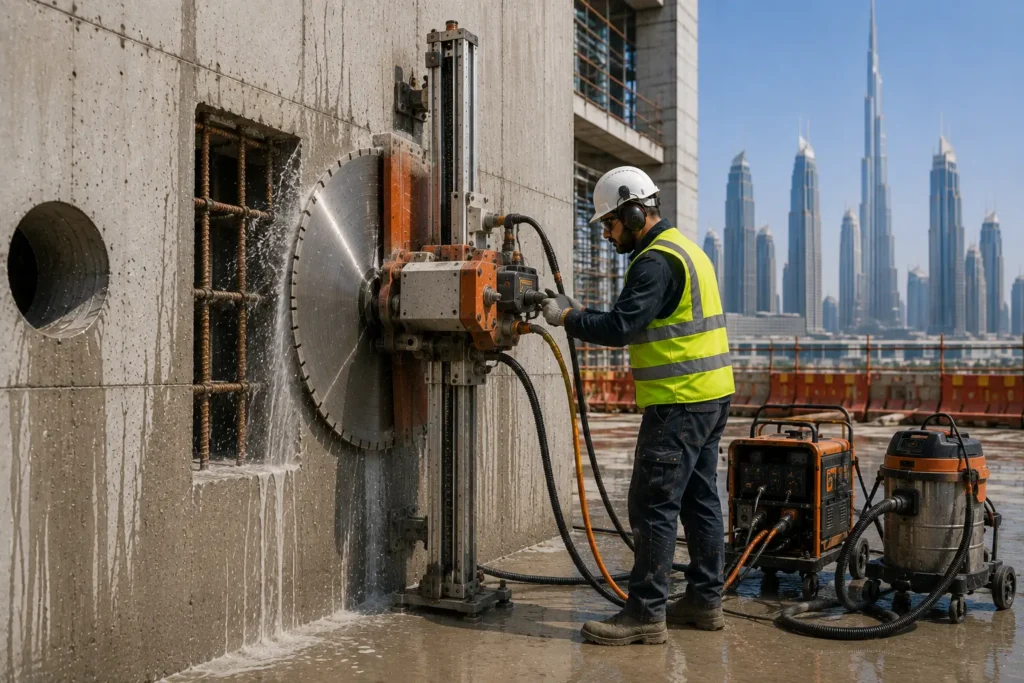
Concrete walls are built to provide strength, stability, and long term durability. However, construction and renovation projects often require these strong structures to be modified. New doors, windows, ventilation systems, electrical routes, plumbing lines, and other building services may require precise openings through existing concrete walls.
A professional Wall Circular Saw provides an effective solution when accuracy and controlled cutting are important. Unlike basic demolition tools that break concrete through repeated impact, professional wall cutting equipment uses a rotating diamond blade to create controlled cuts along a planned line.
Concrete Contractor Dubai provides professional concrete cutting solutions including wall saw cutting, core cutting, slab cutting, roof cutting, wire saw cutting, and demolition. Its wall saw cutting service is designed for concrete walls and vertical structures, with applications including doors, windows, ducts, and structural openings.
What Is a Wall Circular Saw?
A Wall Circular Saw is a specialized concrete cutting system designed to make controlled cuts through vertical surfaces.
The equipment uses a circular diamond blade that rotates at high speed and gradually penetrates the concrete. Depending on the project, the saw can be mounted to a secure track or another suitable support system.
The controlled movement of the saw allows the operator to follow a predetermined cutting path.
This makes the equipment suitable for applications such as:
- Door opening cutting
- Window opening cutting
- HVAC duct openings
- Ventilation openings
- Concrete wall modification
- Structural openings
- Utility service openings
- Controlled concrete removal
The size and type of blade are selected according to the material, wall thickness, required cutting depth, and project requirements.
How Does a Wall Circular Saw Work?
The wall cutting process begins with careful planning.
Before equipment is operated, the required opening is measured and marked on the concrete wall. The technician then evaluates the wall thickness and surrounding area.
If the wall contains reinforcement or concealed services, additional inspection may be necessary.
After the cutting area has been confirmed, the wall saw equipment is positioned securely.
The circular diamond blade is then introduced into the concrete and gradually follows the marked cutting line.
The operator controls the cutting speed and movement throughout the process.
This controlled approach allows the technician to create straight cuts without unnecessarily disturbing areas outside the planned opening.
For larger openings, the concrete may be divided into several sections. These sections can then be removed individually rather than attempting to remove one extremely heavy piece.
Why Diamond Blades Are Used for Concrete Walls
Concrete is a hard construction material, and reinforced concrete can be even more demanding because steel reinforcement is embedded inside it.
Diamond blades are widely used for professional concrete cutting because they are designed for hard materials.
A suitable diamond blade can provide:
- Controlled cutting
- Accurate lines
- Consistent performance
- Efficient penetration
- Suitable performance on reinforced concrete
- Reduced unnecessary impact
The exact blade specification should be selected according to the concrete condition and cutting requirements.
Using the correct blade is particularly important when working with thick or heavily reinforced walls.
Main Applications of a Wall Circular Saw
A professional Wall Circular Saw can be used for many construction and renovation applications.
The most suitable application depends on the required opening shape, size, depth, wall material, and project conditions.
Door Opening Cutting
Creating a new doorway is one of the most common reasons for modifying an existing concrete wall.
During a renovation, the building layout may need to be changed to provide access between two rooms or areas.
A professional wall saw can create controlled cuts around the planned doorway.
The process normally involves:
- Confirming the required doorway dimensions
- Inspecting the wall
- Marking the cutting lines
- Checking for concealed services
- Installing the cutting equipment
- Making the required cuts
- Removing the concrete section
- Inspecting the finished opening
For structural walls, engineering approval should be obtained before cutting.
Window Opening Cutting
Existing buildings may require new or larger windows for natural light, ventilation, or architectural changes.
A Wall Circular Saw can create controlled straight cuts around the required opening.
The dimensions should be confirmed according to the window frame and installation requirements.
Precise measurements are important because an opening that is too large or incorrectly positioned can create additional construction work.
HVAC Duct Openings
Heating, ventilation, and air conditioning systems often require openings through concrete walls.
A new HVAC installation may require a rectangular or specially shaped opening for a duct or ventilation component.
Professional wall cutting can create the required opening according to the dimensions provided by the HVAC contractor.
Before cutting, the technician should confirm:
- Opening width
- Opening height
- Wall thickness
- Required cutting depth
- Duct position
- Surrounding services
Concrete Contractor Dubai specifically lists wall saw cutting for ducts among its applications.
Ventilation Openings
Commercial and industrial properties frequently need ventilation systems.
Ventilation openings may be required in:
- Warehouses
- Restaurants
- Factories
- Workshops
- Commercial buildings
- Residential properties
A professional cutting system can create controlled openings through concrete walls for ventilation equipment.
The opening dimensions should be established before cutting begins.
Plumbing Service Openings
Concrete walls may need openings for plumbing pipes during construction or renovation.
Applications can include:
- Water supply pipes
- Drainage systems
- Wastewater pipes
- Plumbing sleeves
- Mechanical piping
For smaller circular penetrations, core drilling may be more suitable than wall sawing.
The appropriate cutting method depends on whether the project requires a circular hole, straight cut, rectangular opening, or larger wall section removal.
Electrical Service Openings
Electrical systems can require conduits and cables to pass through concrete walls.
A controlled wall cutting process can help create suitable routes or openings for these services.
Before cutting, existing electrical installations should be identified wherever possible.
This is especially important when modifying older buildings where construction drawings may not accurately represent existing services.
Structural Wall Modifications
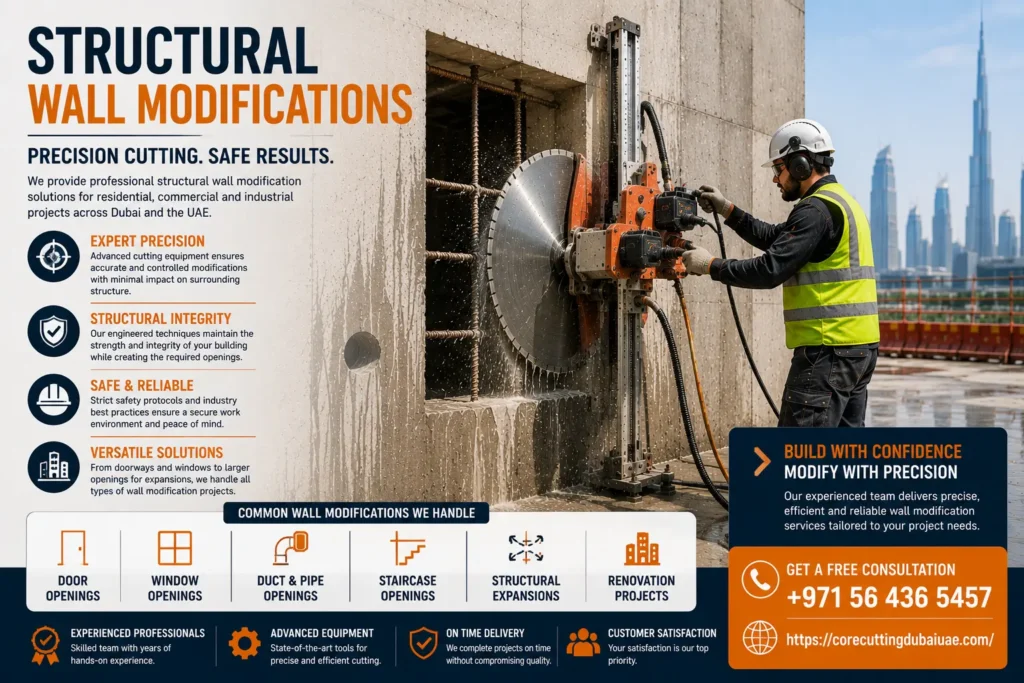
Some projects require modifications to structural concrete walls.
These may involve:
- New access openings
- Building renovations
- Commercial remodeling
- Property conversion
- Service installations
- Structural alterations
Structural walls should always be treated differently from ordinary partitions.
A structural wall can contribute to the stability and load carrying capacity of a building.
Before removing any section, the proposed modification should be assessed according to the project’s engineering requirements.
Wall Circular Saw Equipment
Different projects require different cutting equipment.
A professional contractor should select equipment according to the wall material, thickness, opening dimensions, and required depth.
Track Mounted Wall Saw
A track mounted wall saw uses a guide track secured to the wall.
The saw moves along the track while the diamond blade cuts the concrete.
This arrangement can provide excellent control and is useful when straight and accurate cuts are required.
Hydraulic Wall Saw
Hydraulic wall saw systems can provide high cutting power for demanding concrete applications.
They can be useful for thick reinforced concrete and larger wall openings.
Electric Wall Saw
Electric systems can be suitable for many indoor construction and renovation applications.
The equipment should be selected according to the available power supply and project conditions.
Diamond Cutting Blade
The blade is one of the most important components of the system.
Different blade specifications are available for different concrete conditions.
Factors that can influence blade selection include:
- Concrete strength
- Aggregate type
- Reinforcement
- Wall thickness
- Cutting depth
- Required cutting speed
Using the right blade can improve cutting performance and help maintain a consistent cutting process.
Wall Circular Saw Cutting Process
Professional wall cutting should follow a systematic process.
Site Inspection
The first step is inspecting the wall and surrounding work area.
The technician evaluates the material, wall thickness, access, required opening, and potential obstacles.
Project Measurements
The required opening is measured according to the project drawings or installation requirements.
Accurate measurements are essential before marking the wall.
Marking the Cutting Area
The cutting lines are marked clearly.
The operator checks the dimensions and position before installing the equipment.
Checking Concealed Elements
Existing concrete walls can contain reinforcement, electrical cables, plumbing pipes, and other embedded components.
Where necessary, scanning or detection methods can be used to identify potential obstacles.
Equipment Setup
The wall saw system is securely installed.
Correct alignment is important because even a small positioning error can affect the final opening.
Controlled Cutting
The diamond blade is gradually introduced into the concrete.
The operator controls the movement and cutting speed according to the material.
Concrete Section Removal
Once the cuts are completed, the separated concrete section is removed.
Large sections may be divided into smaller pieces to make handling easier.
Final Inspection
The completed opening is inspected to confirm that it meets the required dimensions and that the cutting work has been completed correctly.
Factors That Affect Wall Cutting Performance
Several factors can influence the efficiency and quality of a concrete wall cutting project.
Concrete Strength
High strength concrete may require specialized equipment and suitable diamond blades.
Wall Thickness
Thicker walls require equipment capable of reaching the required cutting depth.
Reinforcement
Steel reinforcement can affect cutting speed and blade wear.
Opening Dimensions
Large openings require more cuts and more careful concrete removal planning.
Site Access
Restricted areas can make equipment installation and concrete removal more challenging.
Blade Condition
A worn blade can reduce cutting efficiency.
Operator Experience
Experienced technicians can adjust the cutting process according to changing concrete conditions.
Importance of Proper Planning
Wall cutting is not simply a matter of placing a saw against concrete and starting the machine.
Good planning can prevent many common problems.
Before work begins, the contractor should understand:
- Why the opening is required
- Exact opening dimensions
- Wall thickness
- Concrete type
- Reinforcement condition
- Cutting depth
- Site access
- Existing utilities
- Concrete removal requirements
- Safety considerations
A clear plan allows the contractor to select appropriate equipment and establish the safest cutting procedure.
Wall Circular Saw for Renovation Projects

Renovation projects often involve modifying existing concrete structures.
A property owner may want to change an internal layout, create a new access point, install a larger window, or introduce new mechanical services.
Traditional demolition can create unnecessary damage and generate large quantities of debris.
Professional wall sawing provides a more controlled alternative.
The contractor can mark the required section, make precise cuts, and remove only the concrete that needs to be modified.
This can help make renovation work more organized and reduce unnecessary disturbance to surrounding areas.
Wall Circular Saw for Commercial Construction
Commercial properties often require concrete modifications during construction or remodeling.
Examples include:
- Offices
- Retail stores
- Hotels
- Restaurants
- Shopping facilities
- Warehouses
- Commercial kitchens
These projects often need to maintain strict schedules.
Professional wall cutting can help contractors create openings efficiently so other trades can continue with their work.
Concrete Contractor Dubai states that it provides concrete cutting services for residential, commercial, and industrial projects across Dubai.
Benefits of Professional Wall Circular Saw Cutting
Professional wall cutting offers several advantages when an existing concrete wall needs to be modified. The biggest advantage is control. Instead of breaking the wall randomly with impact tools, technicians can create planned cuts around the exact area that needs to be removed.
Precise Cutting Lines
One of the main benefits of professional wall sawing is accuracy.
The required dimensions can be measured and marked before the equipment begins cutting. This is especially important for door openings, windows, ducts, and other structural modifications.
Accurate cutting can also reduce the amount of additional work required after the concrete section has been removed.
Controlled Concrete Removal
A professional wall saw can separate the required section from the surrounding concrete.
For larger openings, the wall can be divided into manageable sections. These pieces can then be removed individually.
This approach can make the removal process easier to control and can reduce unnecessary damage to nearby surfaces.
Suitable for Reinforced Concrete
Many modern buildings use reinforced concrete walls.
Steel reinforcement increases the strength of concrete but also makes cutting more demanding.
Professional diamond cutting equipment can be selected according to the wall thickness, concrete condition, reinforcement, and required cutting depth.
The correct blade and equipment combination is important for maintaining efficient cutting performance.
Smooth and Defined Cuts
A correctly operated diamond cutting system can produce straight and defined cutting lines.
This can be useful when the finished opening needs to receive:
- A door frame
- A window frame
- HVAC equipment
- Ventilation components
- Pipes
- Electrical conduits
- Other building services
Reduced Unnecessary Impact
Wall sawing is a controlled cutting technique rather than a conventional impact demolition method.
This can be beneficial when the surrounding concrete or finishes need to remain intact.
For renovation projects, controlling unnecessary disturbance can be particularly important.
Wall Circular Saw for Door Openings
Creating a new doorway in an existing concrete wall is a common requirement during building renovation.
A property owner may need a new entrance between two rooms, a wider access point, or an additional doorway for a changed floor layout.
The process begins by confirming the required opening dimensions.
The technician then inspects the wall and determines the appropriate cutting method.
After the cutting lines are marked, the saw equipment is positioned and the required cuts are made.
For a large doorway, the concrete may be divided into several pieces before removal.
This makes handling easier and reduces the weight of individual sections.
However, if the wall is structural, the proposed opening should be evaluated according to the project’s engineering requirements before any concrete is removed.
Wall Circular Saw for Window Openings
New window openings may be required during residential or commercial renovation.
A window opening needs accurate dimensions because the finished opening must accommodate the selected frame and installation system.
Professional wall sawing allows the cutting lines to be established according to the required measurements.
The contractor should confirm:
- Window width
- Window height
- Wall thickness
- Opening location
- Required cutting depth
- Surrounding structure
After cutting, the concrete section can be removed and the opening prepared for the next stage of construction.
Wall Circular Saw for HVAC and Duct Openings
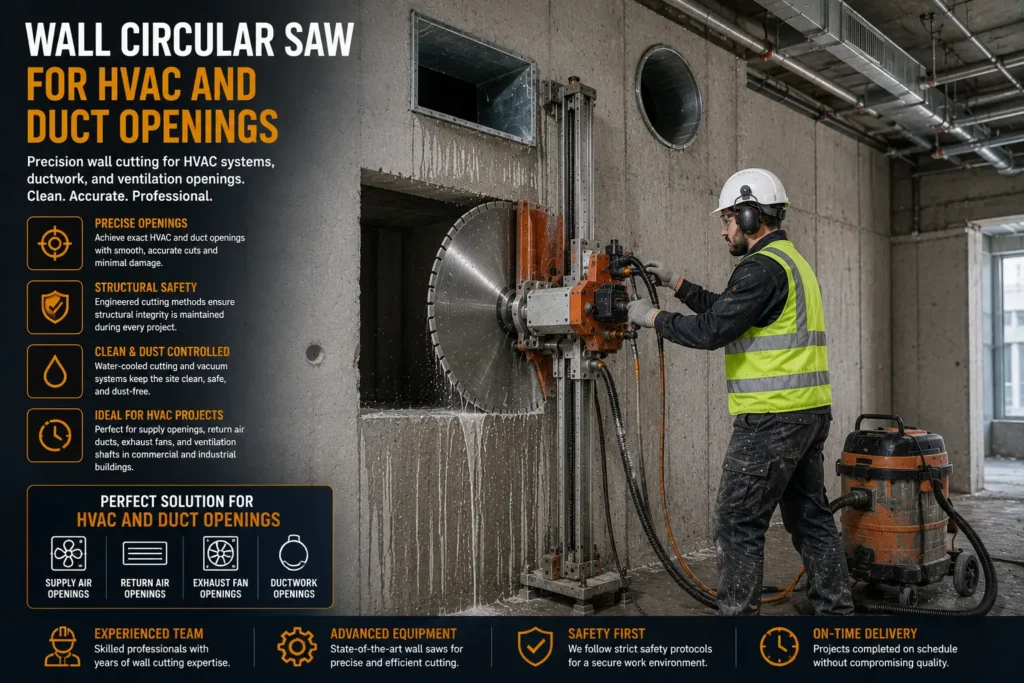
Heating, ventilation, and air conditioning systems frequently require openings through existing walls.
An HVAC duct may require a rectangular or specially shaped penetration.
Professional wall cutting can create the required opening while following the dimensions provided by the mechanical contractor.
Before cutting begins, the technician should verify the opening location and check the surrounding area for potential obstacles.
This is particularly important in existing buildings where electrical, plumbing, or other services may already be concealed inside the wall.
Wall Circular Saw for Plumbing Applications
Concrete walls sometimes need to be modified to accommodate new plumbing systems.
These modifications can involve:
- Water supply pipes
- Drainage pipes
- Wastewater systems
- Plumbing sleeves
- Mechanical pipes
The appropriate cutting method depends on the required opening.
A circular penetration may be better suited to core drilling, while a larger rectangular opening may require wall sawing.
Choosing the correct equipment can improve efficiency and reduce unnecessary concrete removal.
Wall Circular Saw for Electrical Services
Electrical systems may require conduits, cable routes, or service openings through concrete walls.
Before cutting, the proposed location should be checked carefully.
Existing electrical installations can be difficult to identify from the surface, particularly in older buildings.
Where appropriate, scanning or detection methods should be considered before cutting.
A professional contractor can then determine the safest cutting approach based on the available information.
Wall Cutting for Commercial Renovation
Commercial buildings frequently undergo renovations to accommodate new tenants, new layouts, upgraded services, or modernized facilities.
Examples include:
- Offices
- Restaurants
- Hotels
- Retail stores
- Shopping facilities
- Warehouses
- Commercial kitchens
These projects often operate under strict deadlines.
A controlled cutting process can help contractors complete required wall modifications efficiently while allowing other trades to continue with their work.
The work area may also need to be isolated from employees, customers, and other construction teams.
Wall Cutting for Industrial Projects
Industrial facilities can contain thick reinforced concrete walls and specialized structures.
Concrete modifications may be required for machinery installation, ventilation, piping, electrical systems, or structural changes.
Industrial projects can present additional challenges because of:
- Thick concrete
- Heavy reinforcement
- Limited access
- Large concrete sections
- Heavy equipment
- Active production areas
The contractor should inspect the site carefully and select equipment capable of handling the required cutting depth and material.
Wet Cutting and Water Management

Water is commonly used with diamond cutting equipment to help control blade temperature and reduce airborne dust.
During wet cutting, water flows toward the cutting area while the diamond blade operates.
This can provide several advantages, but it also creates concrete slurry.
Concrete slurry consists of water mixed with fine concrete particles.
If it is not controlled, it can spread across floors and surrounding surfaces.
Professional site preparation may therefore include:
- Protective coverings
- Water collection
- Slurry control
- Wet vacuum equipment
- Proper cleanup
Water management is particularly important when wall cutting is performed inside finished buildings.
Dry Wall Cutting
Some projects may require dry cutting because water cannot be used at the location.
Dry cutting eliminates the need to manage cutting water, but it can increase airborne dust.
For this reason, suitable dust control should be considered before starting.
The decision between wet and dry cutting depends on:
- Concrete type
- Wall thickness
- Cutting depth
- Indoor conditions
- Dust requirements
- Water availability
- Equipment specifications
A professional contractor should assess the site before deciding which method is appropriate.
Safety Requirements for Wall Saw Cutting
Concrete wall cutting involves powerful machinery and rotating diamond blades.
Safety should therefore be considered throughout the project.
The work zone should be clearly controlled so unauthorized people do not enter the cutting area.
Suitable personal protective equipment may include:
- Safety helmet
- Eye protection
- Hearing protection
- Protective gloves
- Safety footwear
- Appropriate respiratory protection where required
The equipment should also be inspected before operation.
Technicians should check the cutting blade, mounting system, power supply, water connections, guards, and other important components.
Common Wall Saw Cutting Mistakes
Professional planning helps prevent mistakes that can increase costs or delay construction.
Incorrect Measurements
An incorrectly measured opening can result in a poor fit for the intended door, window, duct, or service.
All dimensions should be confirmed before cutting.
Ignoring Reinforcement
Reinforced concrete can contain significant amounts of steel.
The cutting method and blade should be appropriate for the concrete and reinforcement conditions.
Failing to Check Concealed Services
Electrical cables, pipes, communication systems, and other services may be hidden inside existing walls.
Where applicable, these should be identified before cutting.
Choosing the Wrong Equipment
Not every wall cutting machine is suitable for every application.
Equipment should be selected according to wall thickness, cutting depth, opening dimensions, and site access.
Removing Large Sections Without Planning
Large concrete sections can be extremely heavy.
A suitable lifting and removal plan should be prepared before cutting starts.
Poor Dust and Water Control
Uncontrolled dust or slurry can create additional cleanup and safety problems.
The appropriate control method should be established before work begins.
How to Prepare for a Wall Cutting Project
Good preparation can make the project safer and more efficient.
Confirm the Required Dimensions
The contractor should receive accurate information about the width, height, depth, and location of the required opening.
Review Available Drawings
Architectural and structural drawings can help the contractor understand the proposed modification.
Check Existing Services
Information about plumbing, electrical, HVAC, and communication systems can help identify possible risks.
Clear the Work Area
Unnecessary equipment and materials should be removed from the cutting zone.
Protect Finished Surfaces
Nearby floors, furniture, equipment, and finished walls may require protection from dust, water, and concrete debris.
Plan Concrete Removal
Large sections should be divided and removed in a controlled manner.
This is especially important when cutting thick reinforced concrete.
How to Choose a Professional Concrete Wall Cutting Contractor

Choosing the right contractor is an important part of the project.
Experience
Look for a contractor experienced in concrete walls, reinforced concrete, structural openings, and renovation projects.
Modern Equipment
The company should have suitable cutting equipment and diamond blades for the required application.
Skilled Operators
Experienced operators understand how to control cutting speed, depth, pressure, and equipment movement.
Safety Standards
Professional contractors should maintain suitable safety procedures throughout the project.
Site Assessment
A reliable contractor should inspect the site before providing a final cutting solution.
Clear Project Planning
The contractor should understand the opening dimensions, cutting depth, concrete condition, access, and removal requirements.
Why Choose Concrete Contractor Dubai?
Concrete Contractor Dubai provides professional concrete cutting and structural modification services for residential, commercial, and industrial projects in Dubai.
The company currently lists wall saw cutting as one of its specialized concrete services and describes the service as suitable for concrete walls and vertical structures. Applications include doors, windows, ducts, and structural openings.
The company also provides a wider range of concrete services, including core cutting, roof cutting, slab cutting, wire saw cutting, and demolition.
Its stated working process includes site inspection, project planning and estimation, followed by professional execution using modern equipment and experienced techniques.
This approach is useful when a project requires more than one type of concrete modification.
For example, a renovation project may require a new doorway through a concrete wall, circular penetrations for plumbing, slab cutting for drainage, and controlled demolition for the removed sections.
Having access to different concrete cutting methods can make project coordination easier.
Frequently Asked Questions
What is a Wall Circular Saw?
A Wall Circular Saw is specialized cutting equipment that uses a rotating diamond blade to create controlled cuts through concrete, reinforced concrete, masonry, and other hard wall materials.
What is a Wall Circular Saw used for?
It can be used for door openings, window openings, HVAC ducts, ventilation openings, structural modifications, and other concrete wall cutting applications.
Can a Wall Circular Saw cut reinforced concrete?
Yes. Professional wall saw systems can cut reinforced concrete when suitable equipment and diamond blades are selected for the wall thickness and reinforcement.
Can a wall saw create a doorway?
Yes. Wall sawing can be used to create accurately measured doorway openings in suitable concrete walls.
Can wall sawing be used for windows?
Yes. Professional wall cutting can create controlled openings for new windows or modifications to existing openings.
Is wall sawing suitable for HVAC ducts?
Yes. Wall saw cutting can be used to create openings for HVAC ducts and ventilation systems when the required dimensions and cutting conditions are suitable.
Does wall saw cutting create dust?
Dry cutting can produce concrete dust. Wet cutting can help control airborne dust, although it creates water and concrete slurry that must be managed.
Can wall sawing damage surrounding concrete?
Professional controlled cutting is designed to minimize unnecessary disturbance. However, the final result depends on the structure, equipment, cutting method, and operator.
How long does wall cutting take?
The duration depends on wall thickness, concrete strength, reinforcement, opening dimensions, access conditions, equipment, and the amount of concrete that needs to be removed.
Is a wall saw better than demolition tools?
For projects requiring straight, accurate cuts and controlled concrete removal, professional wall sawing can provide significantly better control than uncontrolled impact demolition.
Conclusion
A professional Wall Circular Saw provides an effective method for modifying concrete walls during construction, renovation, remodeling, and structural projects.
Its ability to create controlled straight cuts makes it useful for door openings, windows, HVAC ducts, ventilation systems, plumbing routes, electrical services, and other building modifications.
For projects in Dubai, professional concrete cutting specialists can provide the equipment and experience needed to perform controlled wall modifications.
Concrete Contractor Dubai provides wall saw cutting along with core cutting, slab cutting, roof cutting, wire saw cutting, and demolition services. The company states that its concrete cutting solutions serve residential, commercial, and industrial projects across Dubai.
Whether you need a small service opening or a large structural wall modification, the correct cutting method should always be selected according to the concrete condition, project requirements, opening dimensions, and site environment.
Get Professional Wall Circular Saw Cutting in Dubai

If your project requires a new door, window, HVAC opening, ventilation route, service penetration, or controlled modification through a concrete wall, professional wall saw cutting can provide an accurate solution.
With accurate planning, suitable diamond cutting equipment, and experienced technicians, concrete wall modifications can be completed with greater control, precision, and efficiency.