Concrete Core & Cutting Contractor Dubai
Professional Concrete Cutting Services in Dubai
Concrete Core & Cutting Contractor Dubai
Professional Concrete Cutting Services in Dubai
Electric Wall Cutter Service in Dubai for Precise Concrete Cutting
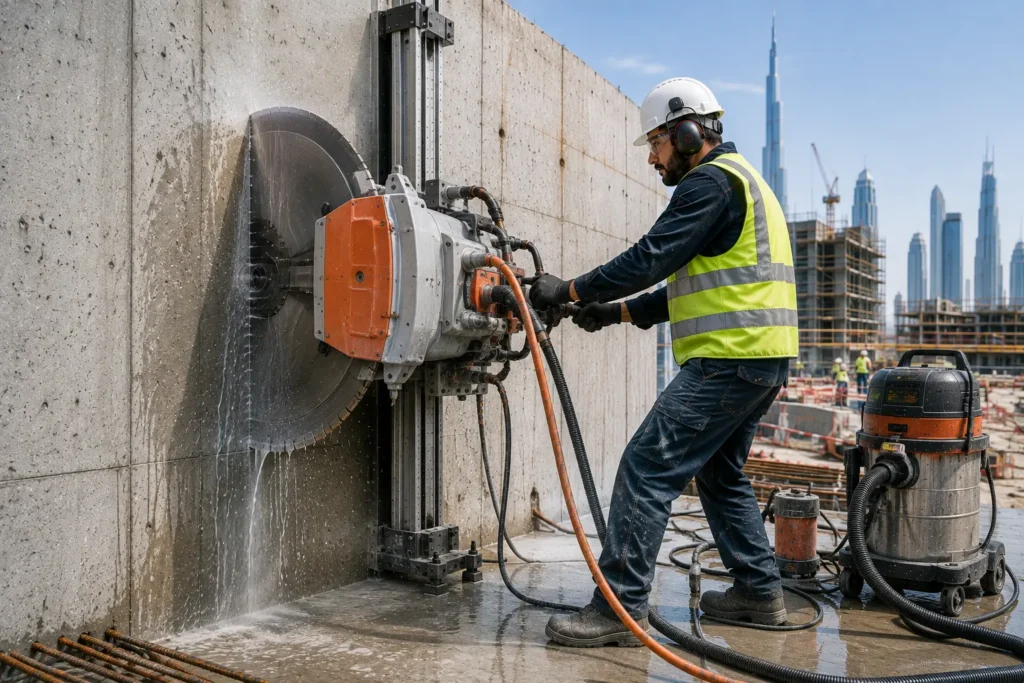
Concrete walls provide strength, stability, and long term durability to buildings, but modifying an existing concrete wall can be a challenging task. When a new doorway, window, ventilation opening, electrical route, or mechanical passage is required, using ordinary cutting tools may not provide the accuracy and control needed for professional construction work.
An Electric Wall Cutter Service provides a practical solution for controlled cutting through concrete and other hard construction materials. Electric wall cutting equipment is designed to use a powerful motor and diamond cutting blade to create straight, accurate cuts through walls and vertical structures.
Concrete Contractor Dubai provides professional concrete cutting services across Dubai, including wall saw cutting, core cutting, slab cutting, roof cutting, wire saw cutting, and demolition. Its wall saw service is designed for accurate cutting of concrete walls and vertical structures for applications such as doors, windows, ducts, and structural openings.
What Is an Electric Wall Cutter?
An electric wall cutter is specialized equipment designed to cut concrete walls using a rotating diamond blade powered by an electric motor.
The machine provides controlled cutting along a predetermined line.
Depending on the equipment and project requirements, the cutting system may be mounted on a guide track or operated using another controlled configuration.
The diamond blade is the main cutting component.
Unlike ordinary construction blades, diamond blades are manufactured with industrial diamond segments that are designed to cut hard materials such as:
- Reinforced concrete
- Concrete blocks
- Masonry
- Stone
- Other suitable construction materials
The exact equipment and blade selection depends on the material, wall thickness, cutting depth, and required opening.
What Is an Electric Wall Cutter Service?
An Electric Wall Cutter Service involves professional technicians using specialized electric wall cutting equipment to create controlled cuts in concrete structures.
The service can be used for different construction and renovation requirements.
Common applications include:
- Door openings
- Window openings
- HVAC duct openings
- Ventilation passages
- Electrical routes
- Plumbing passages
- Structural modifications
- Building renovations
The main objective is to remove only the required section of concrete while maintaining control over the cutting operation.
This makes professional wall cutting different from uncontrolled breaking or demolition.
Why Electric Wall Cutting Is Used in Dubai
Dubai has a large number of residential, commercial, industrial, and infrastructure projects.
Many existing buildings are renovated or modified to accommodate new layouts and modern building services.
For example, an office may require a new doorway between two rooms.
A villa may require a new window opening.
A commercial property may need an opening for an HVAC duct.
A warehouse may require a new service passage through a concrete wall.
In these situations, precise cutting is often more practical than breaking the concrete with heavy impact tools.
Professional wall cutting equipment can create defined cutting lines and allow the required concrete section to be removed in a controlled manner.
How an Electric Wall Cutter Works
The wall cutting process normally begins with an assessment of the work area.
The technician first identifies the location and dimensions of the required opening.
The wall is then examined to understand its thickness, condition, reinforcement, accessibility, and surrounding environment.
The required cutting lines are marked on the wall.
If the project requires it, concrete scanning or other detection methods can be used to identify concealed elements before cutting.
The cutting equipment is then positioned.
A diamond blade suitable for the concrete and cutting requirements is selected.
The blade begins rotating and gradually penetrates the concrete.
The operator controls the cutting movement along the planned line.
For larger openings, several cuts may be required.
After the cuts are completed, the concrete section can be divided into manageable pieces and removed using an appropriate method.
The final opening is then inspected and prepared for the next stage of construction.
Main Components of an Electric Wall Cutter
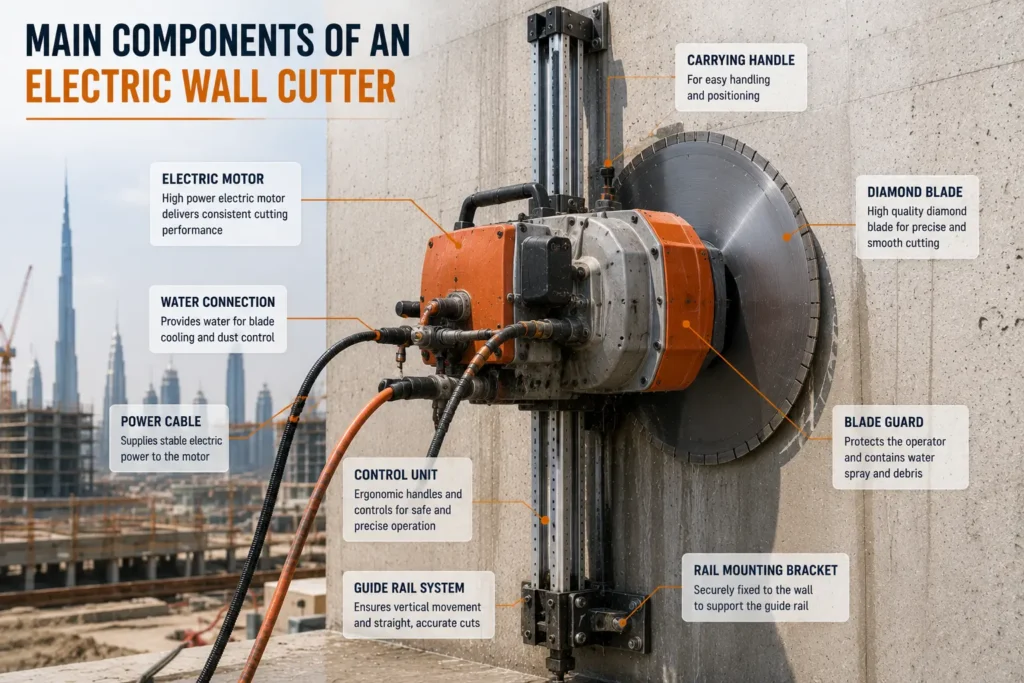
A professional wall cutting system consists of several important components.
Electric Motor
The motor provides the power required to rotate the diamond blade.
The motor capacity should be appropriate for the cutting requirements.
Diamond Blade
The diamond blade performs the actual cutting.
Blade selection depends on the concrete type, reinforcement, required depth, and other project conditions.
Guide System
Many professional wall saw systems use a guide track.
The guide helps the cutting unit move along a predetermined path.
This can improve straightness and overall cutting accuracy.
Mounting System
The equipment needs to be securely positioned before cutting begins.
A stable mounting system helps reduce unwanted movement during operation.
Water Supply
Wet cutting systems may use a controlled water supply during cutting.
Water can help cool the blade and control concrete dust.
Safety Controls
Professional equipment includes controls that allow the operator to manage the cutting operation.
Proper equipment handling and operator training remain essential.
Benefits of Electric Wall Cutter Service
Professional wall cutting provides several advantages over uncontrolled concrete breaking.
Accurate Cutting
One of the biggest advantages is precision.
The operator can follow predetermined cutting lines to create an opening according to the required dimensions.
This is particularly important for doors, windows, HVAC openings, and other installations.
Controlled Operation
Electric wall cutting allows the operator to control the cutting process rather than simply breaking the concrete.
This can help reduce unnecessary damage around the intended opening.
Clean Straight Cuts
Diamond cutting technology can produce relatively smooth and straight cutting lines when the equipment is properly installed and operated.
Suitable for Renovation
Existing buildings often require modifications.
Wall cutting can help contractors create new openings without demolishing a larger section of the wall.
Suitable for Reinforced Concrete
Appropriate diamond cutting equipment can be used for reinforced concrete applications.
However, reinforcement location and structural requirements should be assessed before cutting.
Reduced Unnecessary Impact
Compared with heavy impact demolition, controlled diamond cutting can reduce unnecessary vibration and uncontrolled breaking around the cutting area.
Electric Wall Cutter for Door Openings
Door openings are one of the common applications for professional wall cutting.
A renovation project may require a new doorway between two rooms.
The required width and height are established first.
The cutting lines are then marked accurately.
Before cutting, the wall should be assessed for reinforcement and concealed services.
Once the cutting system is installed, the diamond blade follows the marked lines.
For a large doorway, the concrete section can be separated into smaller pieces.
This makes removal more manageable.
The finished opening can then be prepared for the door frame and installation work.
Electric Wall Cutter for Window Openings
Windows can improve ventilation, natural lighting, and the functionality of a building.
During renovations, an existing concrete wall may need to be modified to create a new window opening or enlarge an existing one.
An Electric Wall Cutter Service can be used to create straight cuts around the planned opening.
Before work starts, the contractor should confirm:
- Window dimensions
- Opening location
- Wall thickness
- Required cutting depth
- Reinforcement
- Frame requirements
- Surrounding structural conditions
Accurate measurements are essential because the finished opening must accommodate the window installation.
Electric Wall Cutter for HVAC Openings
Air conditioning is essential for buildings in Dubai.
HVAC installations may require openings through concrete walls for ducts, pipes, ventilation systems, and mechanical services.
A professional wall cutter can create the required opening according to the dimensions provided by the HVAC contractor.
The cutting location should be coordinated with the mechanical design.
This helps prevent situations where the opening is positioned incorrectly or does not match the required duct dimensions.
Concrete Contractor Dubai specifically lists wall saw cutting for ducts and structural openings among its concrete cutting services.
Electric Wall Cutter for Ventilation Openings
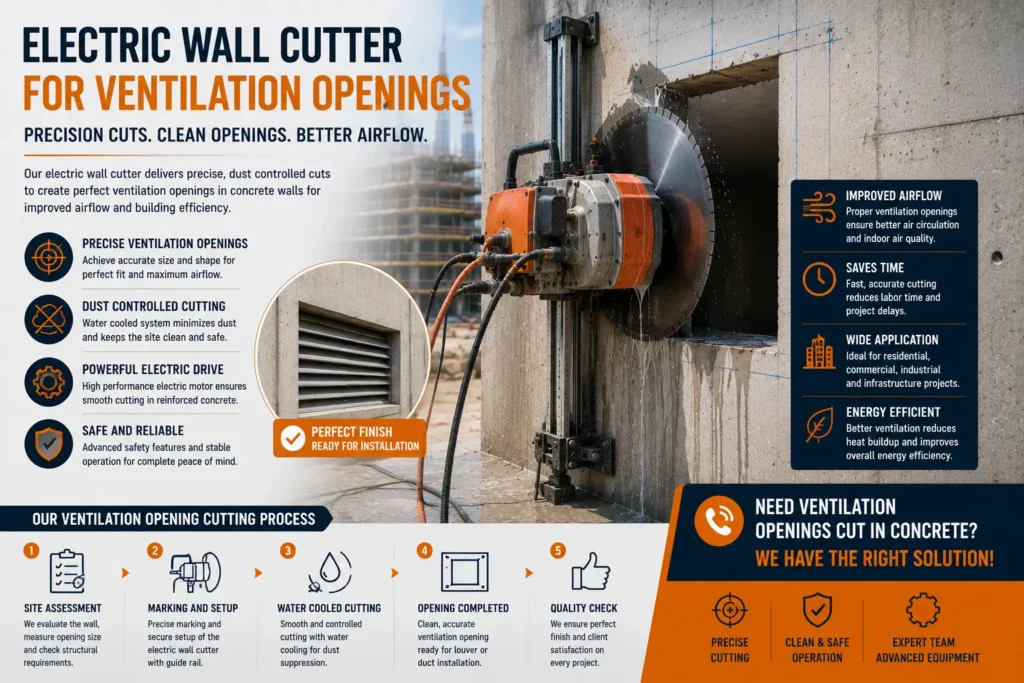
Ventilation systems may require openings through existing concrete structures.
These openings can be needed in residential, commercial, industrial, and hospitality buildings.
Examples include:
- Exhaust systems
- Air circulation
- Mechanical ventilation
- Kitchen ventilation
- Industrial ventilation
The size and shape of the opening determine whether wall cutting, core drilling, or another concrete cutting method is most appropriate.
Large rectangular openings generally require a different cutting approach from small circular penetrations.
Electric Wall Cutter for Electrical Work
Electrical installations sometimes require routes through existing concrete structures.
These may be needed for:
- Electrical conduits
- Cable passages
- Service routes
- Equipment installations
- Utility modifications
Before cutting an existing wall, concealed electrical services should be considered.
Where necessary, scanning or detection should be performed before the cutting operation.
This can help reduce the risk of damaging existing installations.
Electric Wall Cutter for Plumbing Work
Renovation projects may require new plumbing routes through existing walls.
Although smaller pipe penetrations are often created using core drilling, certain plumbing modifications may require straight cuts or larger openings.
The cutting method should be selected according to the required shape and dimensions.
Professional assessment helps determine whether wall cutting or core drilling is more suitable.
Electric Wall Cutter for Structural Modifications
Structural modifications require additional planning.
A concrete wall may carry loads or contribute to the overall stability of the building.
Removing part of such a wall without proper assessment can create serious structural problems.
Before cutting a structural wall, the project should consider:
- Structural drawings
- Wall thickness
- Reinforcement
- Load conditions
- Proposed opening
- Engineering requirements
- Existing building condition
Where required, the work should be reviewed and approved by an appropriately qualified structural professional.
Concrete cutting should begin only after the structural requirements have been addressed.
Concrete Scanning Before Wall Cutting
Existing concrete structures can contain concealed elements.
These may include:
- Steel reinforcement
- Electrical cables
- Water pipes
- Communication lines
- Post tensioning components
- Other embedded services
These elements cannot always be identified by looking at the wall surface.
Concrete scanning can provide additional information before drilling or cutting.
Scanning is particularly valuable for renovation projects where the original construction drawings may be incomplete or unavailable.
The need for scanning depends on the project conditions and the type of structure being modified.
Wet Electric Wall Cutting

Water is commonly used with diamond cutting systems.
During wet cutting, water is directed toward the cutting area.
This can help control heat generated during blade operation and reduce airborne concrete dust.
Wet cutting can be useful for demanding concrete applications.
However, water also creates concrete slurry.
The work area should therefore be prepared before cutting begins.
Suitable protection may include:
- Floor coverings
- Water barriers
- Slurry collection
- Wet vacuum equipment
- Drain protection
- Final cleanup
Proper water management is especially important in completed buildings.
Dry Electric Wall Cutting
Some projects may not allow water.
For example, a finished interior may contain sensitive equipment or electrical systems that make water management difficult.
Dry cutting may be considered when the equipment and application are suitable.
However, dry cutting can create more airborne dust.
Dust control and appropriate protective equipment should therefore be considered.
The decision between wet and dry cutting should be based on the concrete, equipment, cutting depth, location, and site requirements.
Benefits of Professional Electric Wall Cutting
Professional wall cutting can provide important advantages when a construction or renovation project requires a controlled opening through an existing concrete wall.
The main benefit is precision. Instead of breaking the concrete randomly, the cutting team follows planned lines and removes only the section required for the project.
Precise Straight Cuts
An electric wall cutting system can create straight and controlled cuts when properly installed and operated.
This is particularly useful for:
- Door openings
- Window openings
- HVAC openings
- Ventilation passages
- Service openings
- Structural modifications
Accurate cutting can make it easier for the next contractor to install frames, ducts, pipes, or other components.
Controlled Concrete Removal
A professional cutting process allows the wall to be separated into planned sections.
The concrete does not have to be broken randomly across a large area.
This can help reduce unnecessary damage around the opening and make concrete removal more manageable.
Suitable for Reinforced Concrete
Many modern buildings use reinforced concrete.
The concrete contains steel reinforcement that provides additional structural strength.
Suitable diamond cutting equipment can be used for reinforced concrete when the blade and cutting system are selected according to the wall condition.
The operator should also understand that reinforcement can affect cutting speed and blade wear.
Reduced Unnecessary Impact
Heavy impact tools can create vibration and uncontrolled breaking.
Electric diamond wall cutting is based on a controlled cutting process.
This can be beneficial when the surrounding area needs to remain as stable as possible.
Suitable for Renovation Projects
Existing buildings often need modifications.
A property may require a new doorway, larger window, HVAC opening, or service passage.
Professional wall cutting can provide a controlled way to create these openings without removing a larger section than necessary.
Electric Wall Cutter Service for Villa Renovations
Villa renovation projects in Dubai can involve significant changes to existing concrete structures.
Homeowners may want to create:
- New entrances
- Larger windows
- Additional ventilation
- AC openings
- Service passages
- Interior modifications
Before cutting begins, the contractor should inspect the wall and confirm the proposed opening.
The dimensions should be measured carefully.
If the wall is structural, engineering requirements should be addressed before any concrete is removed.
The cutting team can then establish the cutting lines and prepare the equipment.
For larger openings, the concrete may be cut into several sections so that each piece can be removed safely.
Electric Wall Cutter Service for Office Renovations
Office layouts can change as businesses grow or buildings are renovated.
A new office arrangement may require additional doors, windows, HVAC systems, electrical routes, or ventilation.
An Electric Wall Cutter Service can help create suitable openings through existing concrete walls.
The work should be coordinated with the office renovation schedule.
This is especially important when the building remains occupied.
The contractor may need to consider:
- Working hours
- Noise
- Dust
- Water
- Access
- Employee safety
- Protection of finished surfaces
Proper planning can help reduce disruption during the renovation.
Electric Wall Cutter Service for Commercial Buildings
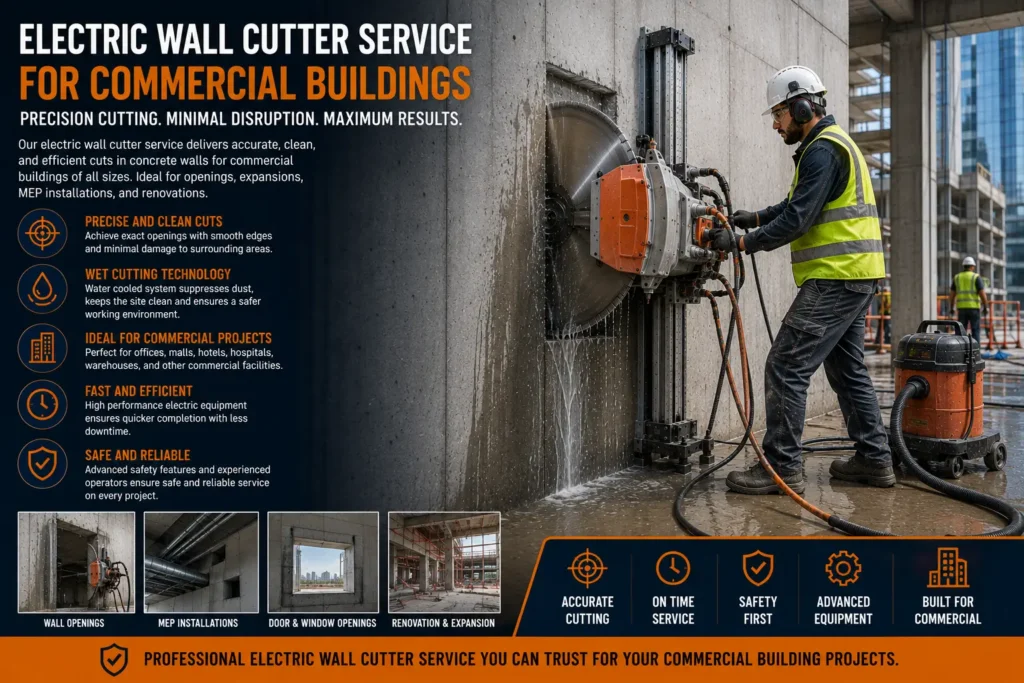
Commercial properties such as shops, restaurants, hotels, and offices frequently undergo upgrades.
New building services may require openings through existing concrete walls.
For example, a restaurant renovation may require openings for ventilation or mechanical systems.
A retail property may require a new doorway.
A hotel renovation may require new service routes for plumbing or HVAC systems.
Professional wall cutting provides a controlled method for these modifications.
Concrete Contractor Dubai lists wall saw cutting for concrete walls and vertical structures, with applications including doors, windows, ducts, and structural openings.
Electric Wall Cutter Service for Industrial Projects
Industrial facilities often contain thick reinforced concrete structures.
Factories, warehouses, workshops, and production facilities may need openings for machinery, ventilation, pipes, electrical systems, or access routes.
Industrial wall cutting can involve more demanding conditions than ordinary residential work.
The contractor may need to evaluate:
- Concrete thickness
- Reinforcement
- Cutting depth
- Equipment access
- Opening dimensions
- Concrete removal
- Lifting requirements
Heavy concrete sections should not simply be allowed to fall after cutting.
A proper removal plan should be established before the work starts.
Electric Wall Cutter Service for HVAC Installation
Air conditioning and ventilation systems are essential for buildings in Dubai.
When an HVAC system is installed or upgraded, concrete openings may be required.
These openings can accommodate ducts, service lines, pipes, or other mechanical components.
The HVAC contractor should provide accurate dimensions before wall cutting begins.
The cutting contractor can then mark the opening according to the approved layout.
This coordination helps prevent incorrect opening sizes.
Electric Wall Cutter Service for Door and Window Openings
Door and window openings require accurate dimensions because the finished opening must accommodate the selected frame.
Before cutting, the contractor should confirm:
- Width
- Height
- Wall thickness
- Opening position
- Required cutting depth
- Frame dimensions
- Structural requirements
The cutting lines should be checked before equipment operation begins.
For larger openings, the concrete can be separated into manageable sections.
This can make removal easier and help protect the surrounding area.
Electric Wall Cutter Service for Structural Openings
Structural openings require careful planning.
A concrete wall may contribute to the structural stability of a building.
Removing a portion of the wall can therefore affect how loads are transferred through the structure.
Before cutting a structural wall, the project should consider:
- Structural drawings
- Reinforcement layout
- Load conditions
- Wall thickness
- Proposed opening
- Engineering approval
- Temporary support requirements
A concrete cutting contractor should follow the approved project requirements.
Concrete cutting should not be used as a substitute for structural engineering.
Concrete Scanning Before Electric Wall Cutting
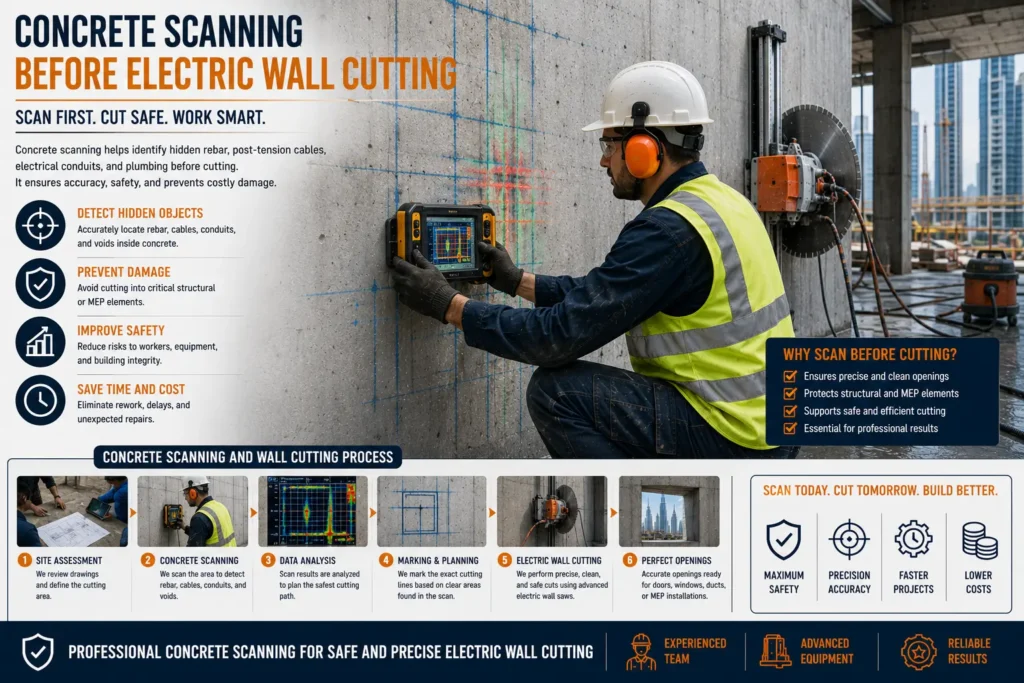
One of the most important preparation steps for existing concrete structures can be identifying concealed elements.
A wall may contain reinforcement, cables, pipes, or other embedded components that cannot be seen from the surface.
Cutting directly through these elements can cause damage and create safety problems.
Where appropriate, concrete scanning can help identify concealed components before cutting begins.
Scanning can be especially useful in:
- Older buildings
- Renovation projects
- Commercial properties
- Industrial facilities
- Structural modifications
- Areas with limited construction records
The need for scanning should be evaluated according to the project and building conditions.
Importance of Diamond Blade Selection
The diamond blade is responsible for cutting through the concrete.
However, not every blade is suitable for every concrete structure.
Blade selection can depend on:
- Concrete strength
- Aggregate type
- Reinforcement
- Wall thickness
- Required cutting depth
- Cutting speed
- Wet or dry operation
A professional contractor should select a blade appropriate for the actual project.
Using an unsuitable blade can reduce cutting efficiency and increase wear.
Wet Cutting With an Electric Wall Cutter
Wet cutting uses water during the diamond cutting process.
Water can help control the temperature of the cutting blade and reduce airborne concrete dust.
This makes wet cutting useful for many demanding concrete applications.
However, the water creates concrete slurry.
The work area therefore needs proper preparation.
The cutting team may use:
- Protective floor coverings
- Water barriers
- Slurry collection
- Wet vacuum systems
- Drain protection
- Cleaning procedures
Water should also be kept away from sensitive electrical equipment.
Dry Wall Cutting Applications
Some projects may not allow water to be used.
In such cases, dry cutting may be considered when the equipment and concrete application are suitable.
The main concern with dry cutting is dust.
Concrete dust can spread through a building if it is not properly controlled.
The contractor should therefore consider suitable dust extraction and protective equipment.
The decision between wet and dry cutting should be made after evaluating the project conditions.
Safety During Electric Wall Cutting
Safety is essential during professional concrete cutting.
An electric wall cutter contains powerful mechanical components and a rotating diamond blade.
The work area should therefore be controlled before cutting begins.
Appropriate protective equipment may include:
- Safety helmet
- Eye protection
- Hearing protection
- Protective gloves
- Safety footwear
- Suitable respiratory protection where required
The equipment should be inspected before operation.
The blade should be checked for condition.
The mounting system should be secure.
The cutting area should remain clear of unauthorized workers.
Managing Concrete Debris
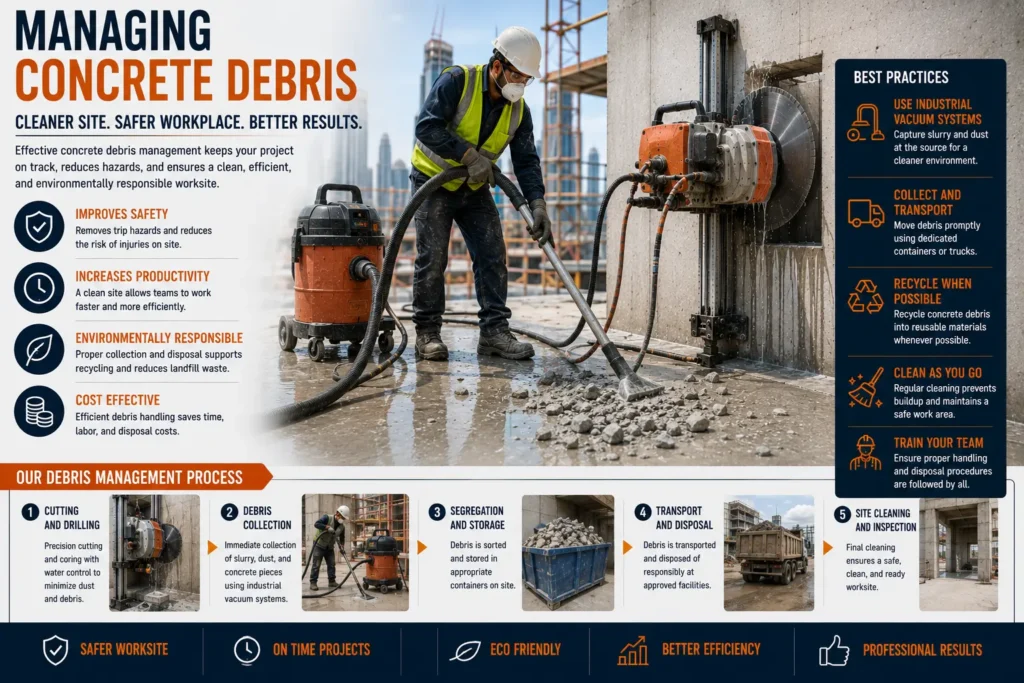
After the wall has been cut, the concrete sections need to be removed.
Small pieces may be manageable by hand when appropriate.
Large concrete sections can be extremely heavy and may require lifting equipment.
Before cutting a large opening, the contractor should determine:
- Approximate section weight
- Removal direction
- Access route
- Lifting equipment
- Temporary support
- Disposal method
This planning helps prevent problems after the cutting stage.
Noise and Dust Management
Concrete cutting produces noise and, depending on the method, dust or slurry.
In an occupied building, these factors should be considered before work begins.
The contractor may need to coordinate working hours with building management.
Dust barriers can be useful for interior renovation work.
Wet cutting can help reduce airborne dust, while slurry needs to be collected and removed.
Good site preparation can help minimize disruption to occupants and other contractors.
Common Mistakes to Avoid
Cutting Without Accurate Measurements
Incorrect measurements can result in an opening that does not match the required installation.
Always confirm dimensions before cutting.
Ignoring Structural Requirements
A structural wall should not be modified without appropriate engineering assessment.
Cutting Without Checking Concealed Services
Existing cables, pipes, and reinforcement can be hidden inside concrete.
Where appropriate, scanning or detection should be performed.
Using the Wrong Blade
Blade selection should match the concrete and cutting requirements.
Poor Equipment Setup
The cutting system should be securely installed and properly aligned before operation.
Poor Debris Planning
Large concrete sections need to be removed safely.
The removal method should be planned before cutting.
Ignoring Water Management
Wet cutting can produce significant slurry.
Water should be contained and removed properly.
How to Prepare Before Hiring a Wall Cutting Contractor
A project becomes easier to manage when the contractor receives clear information before arriving on site.
Provide the Opening Dimensions
Tell the contractor the required width, height, and depth.
Explain the Purpose
Explain whether the opening is for a door, window, duct, ventilation system, plumbing, electrical work, or another purpose.
Share Available Drawings
Structural and architectural drawings can help the contractor understand the existing structure.
Confirm Wall Thickness
Wall thickness affects equipment selection and cutting depth.
Explain Site Access
Restricted access can affect equipment transportation and setup.
Mention Building Occupancy
If people are working or living inside the building, the contractor should know in advance.
Discuss Water Requirements
The contractor should determine whether wet cutting is suitable for the location.
Electric Wall Cutting Compared With Traditional Breaking
Traditional breaking relies on impact tools to fracture concrete.
Electric diamond wall cutting uses a rotating diamond blade to make controlled cuts.
The two methods have different purposes.
| Feature | Electric Wall Cutting | Traditional Breaking |
|---|---|---|
| Cutting Accuracy | High | Lower |
| Cutting Shape | Controlled | Irregular |
| Large Openings | Suitable | Suitable |
| Straight Cuts | Excellent | Limited |
| Vibration | Generally more controlled | Higher |
| Dust Management | Can be managed with wet cutting | Can be significant |
| Concrete Removal | Planned sections | Broken pieces |
| Best Use | Precise openings | General removal |
For projects where accuracy matters, professional wall cutting can be a better choice than uncontrolled breaking.
Electric Wall Cutting Compared With Core Cutting
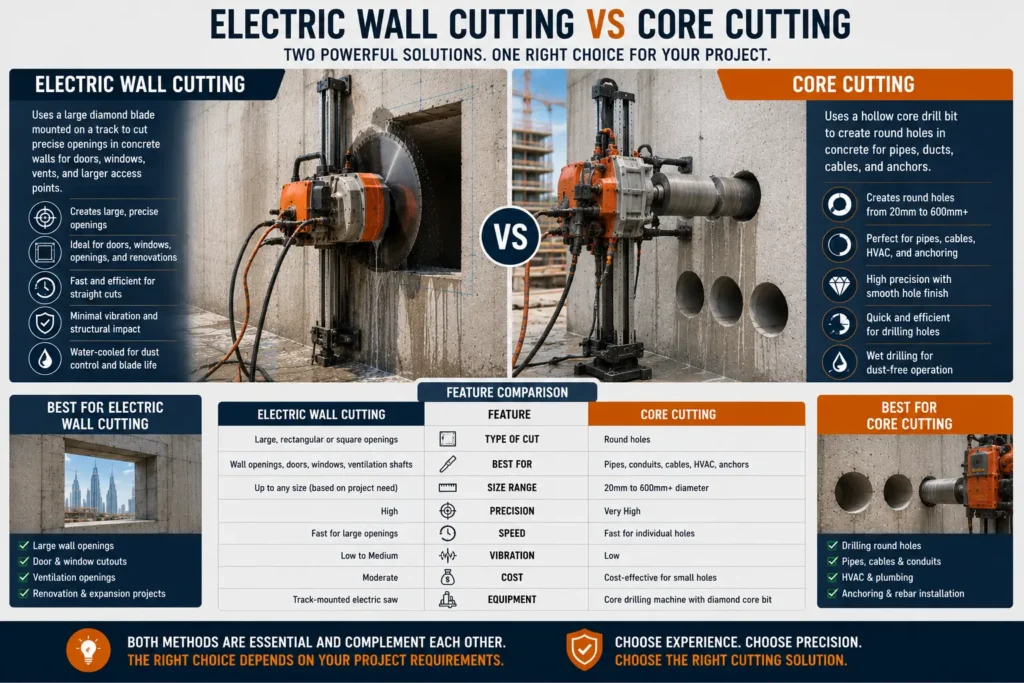
Core cutting and wall cutting are both diamond cutting techniques, but they are designed for different applications.
Core cutting creates circular holes.
Wall cutting creates straight cuts.
Core drilling is generally suitable for:
- Pipes
- Cables
- Drainage
- Small service penetrations
- Circular openings
Wall cutting is generally more suitable for:
- Doors
- Windows
- Large ducts
- Rectangular openings
- Structural passages
Choosing the correct method depends on the required opening shape and dimensions.
Electric Wall Cutting Compared With Wire Saw Cutting
Wire sawing is another specialized concrete cutting technique.
It is often used for very thick or large concrete structures where conventional wall saw equipment may not be the most suitable option.
Electric wall cutting is generally more appropriate for controlled straight cuts on walls and vertical structures.
Wire sawing can be considered when the concrete section is extremely thick or the project geometry makes conventional cutting difficult.
A professional contractor can assess the structure and recommend the appropriate technique.
Why Choose Concrete Contractor Dubai?
Concrete Contractor Dubai provides concrete cutting and structural modification services across Dubai.
Its listed services include core cutting, roof cutting, wire saw cutting, slab cutting, demolition, and wall saw cutting.
The company’s wall saw cutting service is designed for concrete walls and vertical structures and uses diamond blade technology for applications including doors, windows, ducts, and structural openings.
For example, a renovation project may require wall cutting for a doorway, core drilling for plumbing, slab cutting for drainage, and demolition for an unwanted concrete section.
Having different concrete cutting capabilities available can make project coordination more straightforward.
Frequently Asked Questions
What is an Electric Wall Cutter Service?
An Electric Wall Cutter Service uses specialized electric powered equipment and diamond blades to create controlled cuts through concrete walls and other suitable construction materials.
What can an electric wall cutter be used for?
It can be used for doors, windows, HVAC openings, ventilation passages, service openings, and selected structural modifications.
Can electric wall cutters cut reinforced concrete?
Yes. Suitable electric wall cutting equipment and diamond blades can cut reinforced concrete when the machine and blade are selected according to the project conditions.
Is an electric wall cutter suitable for large openings?
Yes. Wall cutting systems are commonly used to create controlled cuts around large openings. The concrete section can then be divided and removed in manageable pieces.
Should concrete be scanned before wall cutting?
Scanning can be useful when reinforcement, electrical cables, pipes, post tensioning elements, or other concealed components may be present.
Is wet cutting better than dry cutting?
The appropriate method depends on the project. Wet cutting can help control dust and blade temperature, while dry cutting may be considered where water cannot be used.
Can an electric wall cutter create a door opening?
Yes. Wall cutting equipment can create straight cuts around a planned doorway when the wall and project conditions are suitable.
Can it be used for HVAC openings?
Yes. Wall cutting can be used to create suitable openings for HVAC ducts and other mechanical services.
Is wall cutting safe for structural walls?
Structural walls require additional assessment. Engineering requirements should be addressed before cutting any structural element.
How do I choose a wall cutting contractor in Dubai?
Consider the contractor’s experience, equipment, blade selection, safety procedures, site assessment process, and ability to handle the specific wall and opening requirements.
Conclusion
An Electric Wall Cutter Service can provide an accurate and controlled solution for modifying concrete walls during construction and renovation projects.
Compared with uncontrolled concrete breaking, diamond wall cutting allows the required cutting lines to be established before the operation begins.
Concrete Contractor Dubai provides professional wall saw cutting and other concrete cutting services in Dubai, using modern equipment and experienced professionals. The company’s listed wall saw service is intended for accurate cutting of concrete walls and vertical structures for doors, windows, ducts, and structural openings.
Get Professional Electric Wall Cutter Service in Dubai

If your construction or renovation project requires a precise opening through a concrete wall, professional electric wall cutting can provide a controlled and practical solution.
Before starting the work, confirm the opening dimensions, wall thickness, cutting depth, purpose, and exact location.
It is also important to consider concealed services, reinforcement, access, water requirements, dust control, and concrete removal.