Concrete Core & Cutting Contractor Dubai
Professional Concrete Cutting Services in Dubai
Concrete Core & Cutting Contractor Dubai
Professional Concrete Cutting Services in Dubai
Core Cutting Company in Dubai Professional Concrete Cutting Services
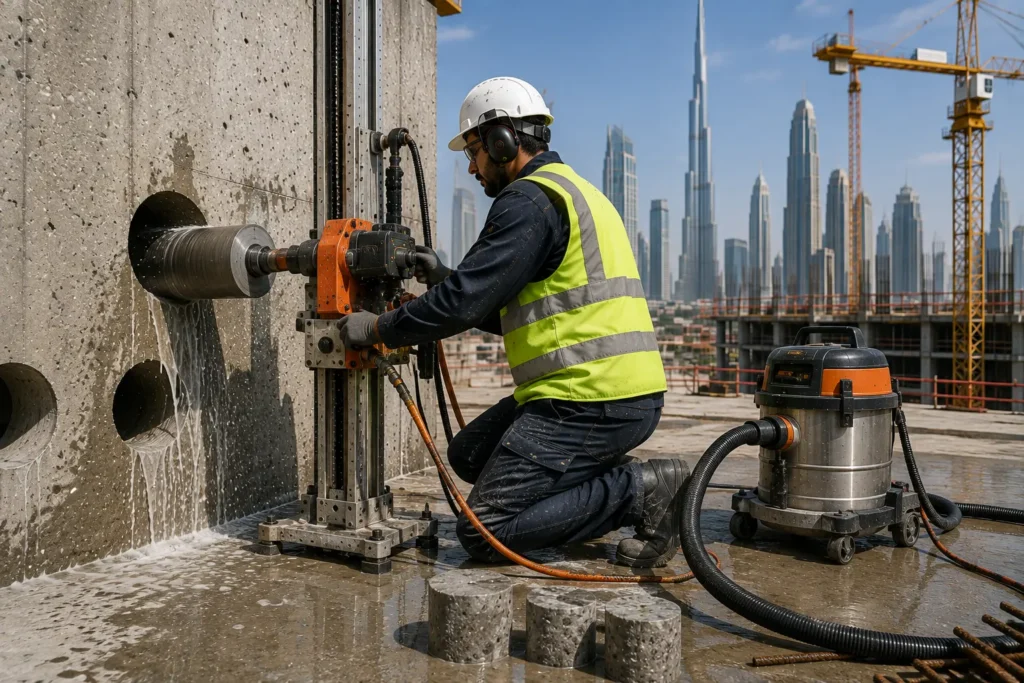
Concrete is one of the most widely used construction materials in Dubai because of its strength, durability, and ability to support demanding structures. However, construction and renovation projects often require precise openings through existing concrete walls, floors, slabs, ceilings, and other structural elements.
Choosing the right Core Cutting Company in Dubai is therefore an important decision for contractors, engineers, property developers, facility managers, and homeowners. The quality of the cutting work can directly affect the next stage of construction, whether the opening is required for plumbing, electrical systems, HVAC installations, drainage, ventilation, or structural modifications.
A professional concrete cutting contractor should have suitable equipment, trained technicians, practical site experience, and a clear understanding of concrete structures.
Concrete Contractor Dubai provides professional concrete cutting solutions across Dubai, including core cutting, wall saw cutting, slab cutting, roof cutting, wire saw cutting, and demolition. Its core cutting service is designed to create precise circular openings in concrete walls, slabs, and floors for residential, commercial, and industrial projects.
What Is Concrete Core Cutting?
Concrete core cutting is a specialized drilling process used to create circular openings through concrete structures.
Instead of breaking the concrete around the required area, a cylindrical section is drilled and removed using a diamond core bit.
The resulting hole can then be used for different construction services.
Common applications include:
- Plumbing pipes
- Electrical conduits
- HVAC systems
- Ventilation ducts
- Drainage pipes
- Cable routes
- Anchor installations
- Mechanical services
- Utility penetrations
Core drilling is particularly useful when a project requires a clean circular opening.
The diameter of the opening can be selected according to the installation requirements.
For example, a small opening may be sufficient for an electrical conduit, while a larger diameter may be required for a drainage pipe or mechanical system.
Why Hire a Professional Core Cutting Company in Dubai?
Concrete cutting may appear simple from the outside, but professional core drilling requires appropriate equipment, accurate measurements, and experienced operation.
Hiring a professional contractor provides several advantages.
Accurate Hole Dimensions
Professional core drilling equipment is designed to create controlled circular openings.
This is important when the hole needs to match the exact diameter of a pipe, cable sleeve, duct, or mechanical component.
Reduced Structural Disturbance
Controlled diamond drilling removes a specific cylindrical section rather than breaking a large surrounding area.
This can help reduce unnecessary disturbance to the concrete.
Suitable for Reinforced Concrete
Many modern structures contain steel reinforcement.
Professional diamond core drilling equipment can be selected according to the concrete condition and reinforcement requirements.
Better Project Efficiency
Experienced technicians understand how to set up the equipment and perform the drilling operation efficiently.
This can help reduce delays on construction and renovation projects.
Improved Safety
Professional operators understand equipment handling, work area control, water management, and concrete debris management.
These factors are important when drilling inside occupied buildings or active construction sites.
How Does Concrete Core Cutting Work?
A professional core cutting project normally follows a structured process.
Site Inspection
The first step is to inspect the location where the opening is required.
The technician evaluates:
- Concrete type
- Surface condition
- Thickness
- Required hole diameter
- Access
- Nearby services
- Reinforcement
- Working environment
This information helps determine the appropriate drilling method.
Marking the Drilling Location
The exact center point of the required hole is marked on the concrete surface.
Accurate marking is important because even a small positioning error can affect pipe, cable, or duct installation.
Checking for Concealed Services
Existing concrete structures may contain electrical cables, pipes, reinforcement, or other embedded elements.
Where appropriate, scanning or detection should be considered before drilling.
This is especially important in existing buildings where original construction information may not be available.
Equipment Setup
The core drilling machine is positioned at the required location.
Depending on the application, the equipment may be securely anchored to the concrete surface.
Correct alignment is important for maintaining the required drilling direction.
Diamond Core Drilling
The diamond core bit begins rotating and gradually penetrates the concrete.
Water may be used during the drilling process to cool the diamond segments and control dust.
The operator monitors the drilling operation and adjusts the process according to the concrete conditions.
Core Removal
Once the drilling reaches the required depth, the cylindrical concrete core is removed.
The opening is then inspected to confirm that it matches the project requirements.
What Is a Diamond Core Bit?
A diamond core bit is a cylindrical cutting tool designed for drilling holes through hard construction materials.
Its cutting edge contains industrial diamond segments.
As the bit rotates, these segments gradually grind through concrete.
Diamond core bits are available in different diameters and specifications.
The correct bit depends on:
- Required hole diameter
- Concrete strength
- Reinforcement
- Drilling depth
- Aggregate type
- Project requirements
Selecting the correct core bit can improve drilling efficiency and help maintain consistent results.
Main Applications of Core Cutting in Dubai
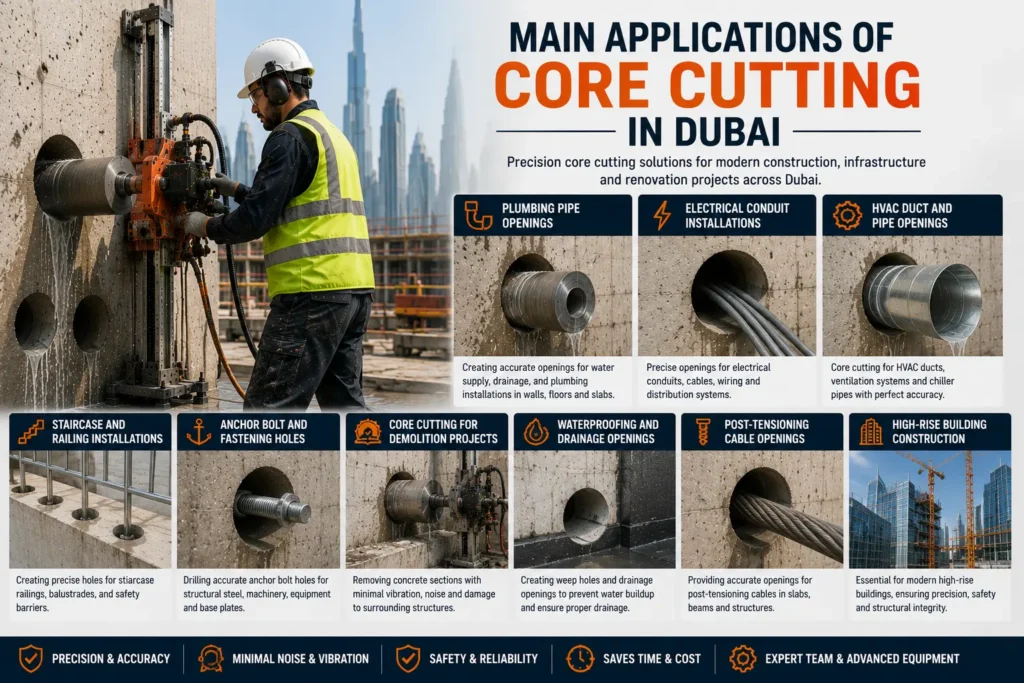
A professional Core Cutting Company in Dubai can support many construction and renovation applications.
Plumbing Pipe Openings
Plumbing installations often require pipes to pass through concrete walls, floors, and slabs.
Core drilling can create circular openings for:
- Water pipes
- Drainage pipes
- Wastewater systems
- Plumbing sleeves
- Mechanical piping
The hole diameter should be selected according to the pipe and sleeve dimensions.
Accurate positioning is equally important because the opening needs to align with the planned plumbing route.
HVAC Installations
Dubai buildings depend heavily on air conditioning and ventilation systems.
HVAC installations frequently require openings through concrete structures.
Core drilling can create circular penetrations for:
- Refrigerant lines
- Condensate pipes
- Mechanical services
- Small ventilation routes
- HVAC supports
Larger rectangular duct openings may require wall sawing rather than core drilling.
The appropriate method depends on the shape and dimensions of the required opening.
Electrical Cable Penetrations
Electrical systems often require cables and conduits to pass through concrete walls or floors.
Core drilling can provide controlled circular openings for conduit systems.
Before drilling, existing electrical services should be identified wherever possible.
This can reduce the risk of damaging concealed installations.
Drainage Systems
Drainage pipes frequently need to pass through concrete floors, slabs, and walls.
Core drilling can provide the required circular opening while maintaining control over the surrounding concrete.
The hole should be positioned according to the drainage design and required pipe slope.
Ventilation Systems
Commercial and industrial buildings may require ventilation openings.
Depending on the system design, core drilling can be used for smaller circular penetrations and service routes.
Larger ventilation openings may require wall saw cutting.
A professional contractor can determine which cutting method is more suitable after reviewing the project requirements.
Anchor and Fixing Applications
Core drilling can also support certain construction and mechanical installation requirements.
Circular holes may be required for:
- Anchoring systems
- Equipment installation
- Structural supports
- Mechanical components
- Specialized fixtures
The required diameter and depth should be determined according to the installation specifications.
Core Cutting in Residential Projects
Residential properties may require concrete drilling during construction, renovation, or maintenance.
Common applications include:
- Plumbing installation
- AC systems
- Electrical services
- Drainage
- Water tanks
- Ventilation
- Renovation work
For example, a villa renovation may require several new openings through a concrete slab for plumbing and drainage.
Using professional core drilling equipment can help create the required holes without unnecessarily damaging the surrounding structure.
Core Cutting in Commercial Buildings
Commercial buildings often contain complex mechanical and electrical systems.
During renovation or fit out projects, contractors may need to introduce new services through existing concrete structures.
Applications can include:
- Office renovations
- Retail fit outs
- Hotel upgrades
- Restaurant construction
- Commercial kitchens
- HVAC installation
- Electrical upgrades
Commercial projects often require careful scheduling because multiple trades may be working simultaneously.
Professional core drilling can help contractors complete required penetrations efficiently so other installation work can continue.
Core Cutting in Industrial Projects
Industrial facilities can contain thick concrete structures and demanding working conditions.
Core drilling may be required for:
- Machinery installation
- Pipe routes
- Electrical systems
- Ventilation
- Drainage
- Mechanical equipment
- Structural services
Industrial drilling may require larger diameter core bits or deeper drilling capabilities.
The contractor should inspect the structure and select equipment according to the project requirements.
Wet Core Cutting
Water is commonly used during professional diamond core drilling.
The water flows around the drilling area and helps control heat generated by friction between the diamond bit and concrete.
Wet drilling can provide several benefits.
Blade and Bit Cooling
Water helps control the temperature of the diamond segments during operation.
Dust Control
Water can reduce airborne concrete dust during drilling.
Continuous Drilling
Proper water flow can support consistent drilling conditions.
However, wet drilling also produces concrete slurry.
The work area should therefore be prepared to control water and slurry.
This may involve:
- Protective coverings
- Water collection
- Wet vacuum systems
- Slurry containment
- Final cleanup
Water management becomes particularly important inside finished buildings.
Dry Core Drilling
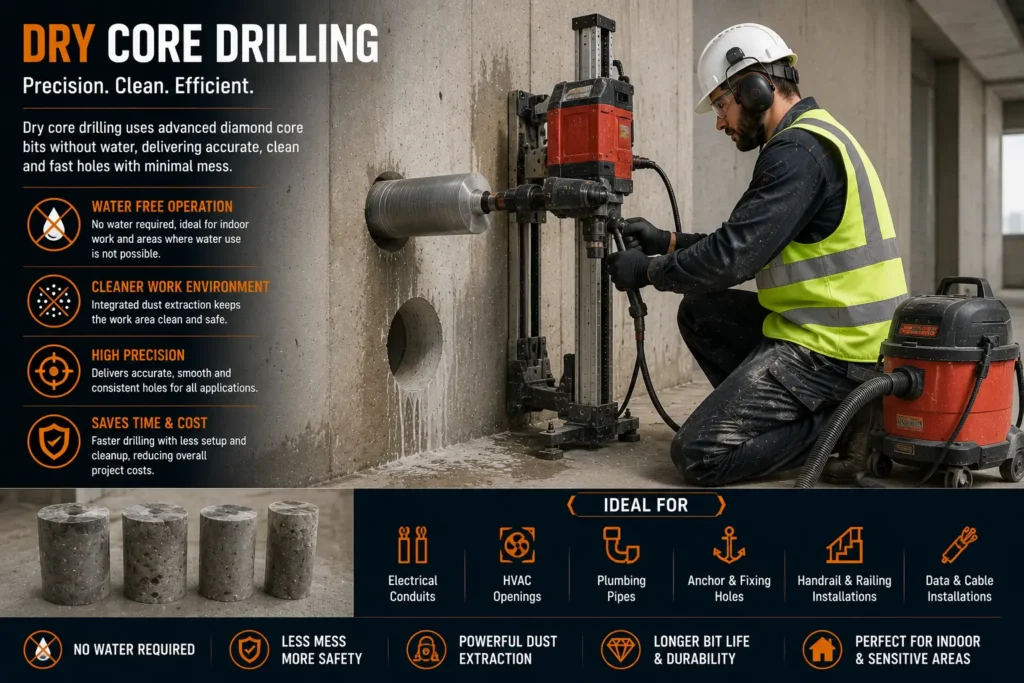
Some projects may require dry drilling.
This can be useful where water cannot be used because of sensitive equipment, finished interiors, electrical concerns, or other site restrictions.
However, dry drilling can produce more dust.
The contractor should therefore determine whether suitable dust extraction and control measures are available.
The choice between wet and dry drilling depends on the material, hole size, drilling depth, location, and project conditions.
Factors That Affect Core Cutting Performance
Several factors influence the efficiency and quality of a core drilling project.
Concrete Strength
High strength concrete may require specialized diamond equipment.
Hole Diameter
Larger holes generally require larger core bits and may require additional equipment capacity.
Drilling Depth
Deep drilling requires equipment and core bits capable of reaching the required depth.
Reinforcement
Steel reinforcement can affect drilling speed and diamond bit wear.
Aggregate
The type and hardness of aggregate inside the concrete can influence drilling performance.
Access
Restricted access can make equipment positioning more difficult.
Operator Experience
Experienced technicians can adjust the drilling process according to the concrete condition and project requirements.
Benefits of Professional Core Cutting
Professional core cutting provides several advantages when a construction project requires accurate circular openings through concrete.
The main benefit is control. Instead of breaking a large area of concrete, the technician removes only the cylindrical section required for the installation.
Precise Circular Openings
Diamond core drilling is designed to create circular openings with controlled dimensions.
This is useful when a hole needs to accommodate a pipe, cable, sleeve, duct, or mechanical component.
Accurate positioning also helps other contractors continue their installation work without unnecessary modification.
Reduced Unnecessary Damage
Core drilling removes a specific section of concrete rather than breaking the surrounding surface.
This can help maintain the condition of the surrounding structure when the project requires a clean and controlled opening.
Suitable for Different Concrete Structures
Professional core cutting can be performed on various concrete surfaces depending on equipment capacity and project requirements.
Applications can include:
- Concrete walls
- Concrete floors
- Structural slabs
- Roof slabs
- Foundations
- Concrete partitions
- Reinforced concrete structures
Controlled Drilling
The drilling equipment can be positioned and secured according to the required location and direction.
This helps the operator maintain control throughout the drilling operation.
Professional Finish
A properly performed core hole can provide a clean circular opening that is ready for the next construction stage.
This can be particularly important for mechanical and electrical installations where the opening needs to match the specified dimensions.
Choosing the Right Core Cutting Company in Dubai
Dubai has a large construction and renovation industry, so many projects require specialized concrete cutting services.
However, contractors should not select a service provider based only on price.
Several factors should be considered before hiring a Core Cutting Company in Dubai.
Experience With Concrete Structures
A professional company should have practical experience working with concrete walls, floors, slabs, roofs, and reinforced structures.
Different concrete conditions can require different cutting techniques.
Modern Equipment
The company should have suitable drilling machines, diamond core bits, water systems, and supporting equipment.
Modern equipment can improve drilling efficiency and help maintain accuracy.
Skilled Technicians
Equipment alone does not guarantee a quality result.
Experienced operators understand how to position the machine, control drilling pressure, manage water flow, and respond to reinforcement or changing concrete conditions.
Safety Procedures
Concrete drilling involves rotating machinery, electrical equipment, water, concrete debris, and potentially concealed services.
A professional company should follow suitable safety procedures throughout the project.
Site Assessment
A reliable contractor should understand the site before starting the drilling operation.
The assessment can help identify access limitations, concrete thickness, required hole diameter, and potential obstacles.
Clear Project Estimate
The quotation should clearly explain the required work.
Depending on the project, pricing can be influenced by:
- Number of holes
- Hole diameter
- Drilling depth
- Concrete thickness
- Reinforcement
- Site access
- Working conditions
- Required equipment
Core Cutting for High Rise Buildings
High rise construction is common throughout Dubai.
These projects often require numerous concrete penetrations for mechanical, electrical, plumbing, and ventilation systems.
Core drilling may be required in:
- Concrete floors
- Walls
- Structural slabs
- Service areas
- Mechanical rooms
- Plant rooms
High rise projects can present additional challenges because work may take place at considerable height or inside occupied buildings.
Equipment selection and site safety therefore become especially important.
The drilling team should coordinate with the main contractor and other trades to ensure that openings are created at the correct locations.
Core Cutting for Villa Renovations
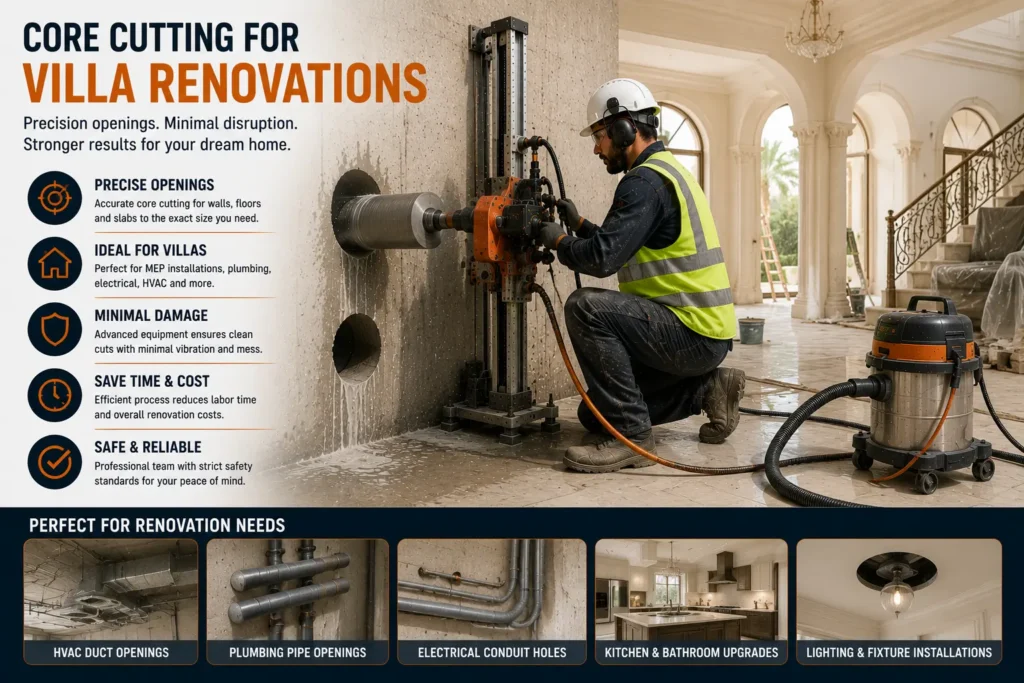
Villa renovation projects can also require concrete drilling.
Homeowners may need new openings for:
- Plumbing
- Drainage
- Air conditioning
- Electrical services
- Ventilation
- Water systems
For example, a renovation contractor may need to install a new drainage pipe through an existing concrete slab.
A professional core drilling machine can create the required circular opening without removing a large surrounding section of concrete.
Core Cutting for Office Renovation
Office buildings frequently require modifications when layouts change.
A new office arrangement may require additional electrical conduits, communication cables, HVAC services, or plumbing.
Core cutting can create controlled penetrations through concrete structures for these installations.
The drilling work should be coordinated with the electrical, mechanical, and plumbing contractors.
This helps ensure that each opening is positioned according to the final service layout.
Core Cutting for Hotels and Hospitality Buildings
Hotels often require continuous upgrades and renovation.
Concrete drilling may be required for:
- Plumbing upgrades
- HVAC systems
- Electrical installations
- Drainage
- Ventilation
- Fire protection systems
Because hotels may remain operational during renovation, careful work area management is important.
Water, dust, noise, and debris should be controlled according to the building’s operational requirements.
Core Cutting for Industrial Facilities
Industrial buildings can require larger and deeper concrete openings.
Factories, warehouses, workshops, and production facilities may need penetrations for:
- Industrial pipes
- Drainage systems
- Mechanical equipment
- Electrical installations
- Ventilation
- Machinery supports
Industrial concrete can also contain significant reinforcement.
The drilling equipment should therefore be selected according to the actual site conditions.
Core Cutting and Concrete Reinforcement
Reinforced concrete contains steel bars that provide structural strength.
When drilling through reinforced concrete, the diamond core bit may encounter steel reinforcement.
This can affect drilling speed and bit wear.
Before drilling, the contractor should determine whether reinforcement is present and whether the proposed opening is structurally acceptable.
For sensitive structural applications, concrete scanning may be appropriate before drilling.
The position of reinforcement can help the contractor understand where the opening can be created and whether the planned location requires modification.
Core Cutting and Concrete Scanning
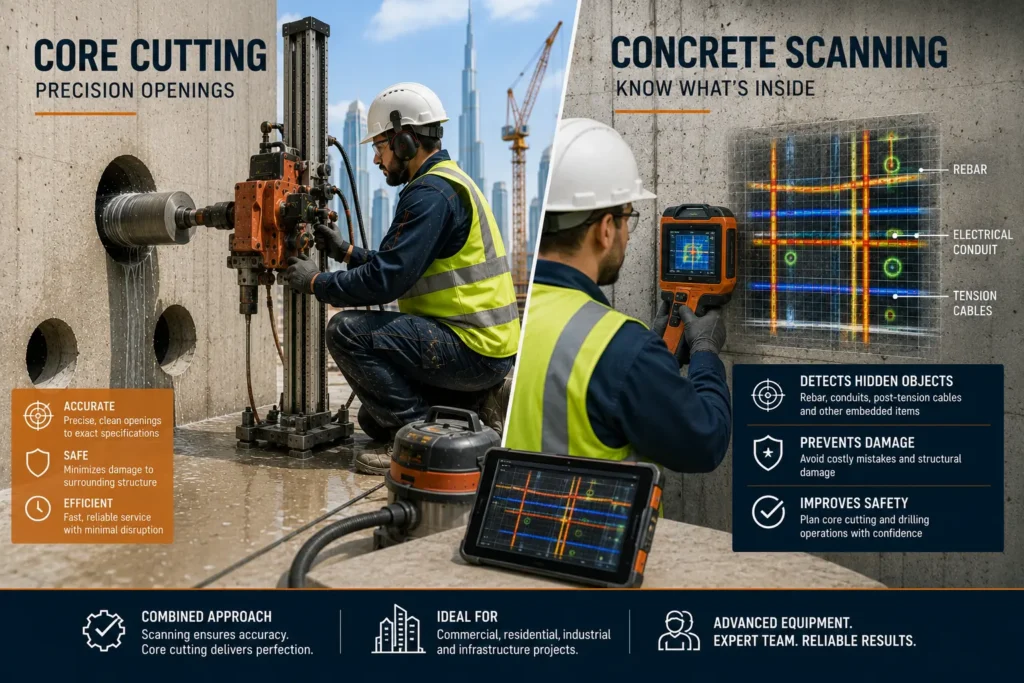
Concrete scanning can provide valuable information before drilling.
A concrete surface may appear completely solid, while its interior could contain:
- Steel reinforcement
- Electrical cables
- Water pipes
- Communication cables
- Post tensioning elements
- Other embedded components
Drilling without considering these hidden elements can create serious problems.
For this reason, scanning can be particularly useful for existing buildings and sensitive structural areas.
The decision to scan should depend on the project conditions and the information already available.
Water and Slurry Management
Wet core cutting is commonly used because water helps cool the diamond bit and control dust.
However, the process produces slurry.
If slurry is allowed to spread across the work area, it can create additional cleaning and safety issues.
Professional preparation may include:
- Floor protection
- Water barriers
- Collection systems
- Wet vacuum equipment
- Slurry removal
- Final cleaning
This is especially important inside completed commercial buildings, villas, offices, hotels, and other finished properties.
Noise Considerations
Concrete drilling produces noise.
The level of noise depends on the equipment, concrete condition, drilling diameter, and site environment.
In occupied buildings, the work may need to be scheduled during suitable hours.
Commercial projects may require coordination with building management.
Residential projects may require additional consideration for nearby occupants.
Planning the drilling schedule can help reduce unnecessary disruption.
Safety Measures During Core Cutting
Professional core drilling requires appropriate safety precautions.
The work area should be controlled before equipment operation begins.
Technicians may need to use:
- Safety helmets
- Eye protection
- Hearing protection
- Protective gloves
- Safety footwear
- Suitable respiratory protection where required
The drilling equipment should be inspected before use.
The operator should also ensure that the machine is securely positioned and that the drilling area is free from unnecessary obstacles.
Electrical equipment should be protected from water during wet drilling.
Common Core Cutting Mistakes
Drilling Without Accurate Measurements
Incorrect measurements can result in a hole being positioned incorrectly.
The location should be confirmed before drilling begins.
Ignoring Concealed Services
Existing cables and pipes may be hidden inside concrete.
Where appropriate, detection or scanning should be performed.
Using the Wrong Core Bit
The bit diameter and specification should match the required opening and concrete condition.
Applying Excessive Pressure
Forcing the drilling equipment can reduce efficiency and place unnecessary stress on the machine and diamond bit.
Controlled drilling is generally more effective.
Poor Water Management
Insufficient water can affect drilling conditions, while uncontrolled water can create slurry problems.
Water flow should be managed according to the equipment and site conditions.
Failing to Plan Core Removal
Deep drilling can produce a substantial cylindrical concrete core.
The contractor should have a plan for safely removing and handling it.
How to Prepare Before Hiring a Core Cutting Contractor
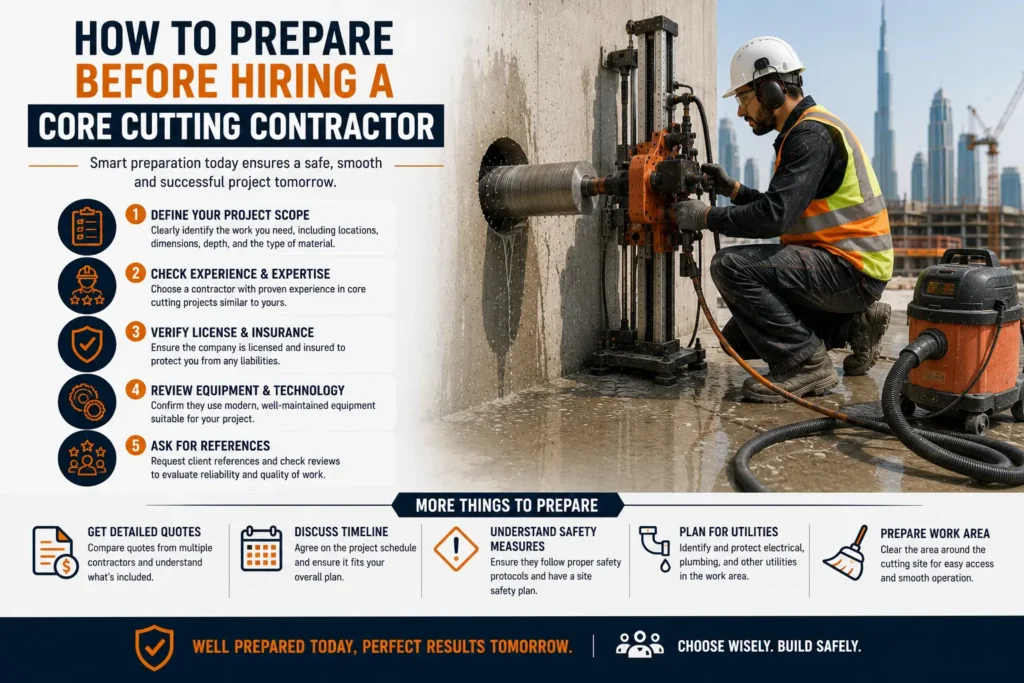
Before contacting a concrete cutting company, gather as much project information as possible.
Identify the Required Hole Size
Determine the required diameter of each opening.
Confirm the Drilling Depth
The contractor should know whether the hole needs to pass completely through the concrete or only reach a specific depth.
Identify the Surface
Specify whether the opening is required through a wall, floor, roof, slab, or another concrete structure.
Provide Drawings
Architectural and structural drawings can help the contractor understand the project.
Explain the Purpose
Tell the contractor whether the opening is required for plumbing, HVAC, electrical services, drainage, ventilation, or another application.
Share Site Conditions
Information about access, working hours, building occupancy, and surrounding equipment can help the contractor prepare properly.
When Core Cutting Is Better Than Other Cutting Methods
Different concrete cutting techniques are designed for different applications.
Core drilling is generally suitable when the required opening is circular.
Wall sawing is more appropriate when a project requires straight cuts or large rectangular openings.
Slab cutting can be suitable for cutting concrete floors and structural slabs.
Wire sawing may be considered for very large or thick concrete structures.
Demolition is more appropriate when an entire structure or large section needs to be removed.
Selecting the correct technique can improve project efficiency and reduce unnecessary work.
Core Cutting Versus Wall Saw Cutting
The two methods are both useful but serve different purposes.
| Feature | Core Cutting | Wall Saw Cutting |
|---|---|---|
| Opening Shape | Circular | Straight or rectangular |
| Typical Use | Pipes and cables | Doors and windows |
| Cutting Method | Diamond core bit | Diamond circular blade |
| Small Penetrations | Excellent | Usually not necessary |
| Large Openings | Limited | More suitable |
| HVAC Pipes | Suitable | Usually unnecessary |
| Large Duct Openings | Limited | Suitable |
The correct method should always be selected according to the required opening.
Why Choose Concrete Contractor Dubai?
Concrete Contractor Dubai provides professional concrete cutting solutions for residential, commercial, and industrial projects in Dubai.
Its listed services include core cutting, roof cutting, wire saw cutting, slab cutting, demolition, and wall saw cutting.
The company’s core cutting service is described as using advanced drilling equipment to create precise circular openings in concrete walls, slabs, and floors.
The company also highlights modern equipment and an experienced team as part of its concrete cutting services. Its stated working process includes site inspection, planning and estimation, and professional execution.
This approach can be valuable for projects where accurate drilling and careful coordination are required.
A project may involve several different concrete cutting requirements at the same location. For example, a commercial renovation may need core holes for plumbing, wall cutting for a new doorway, slab cutting for drainage, and controlled demolition for a removed section.
Having access to multiple concrete cutting techniques can make project coordination more convenient.
Frequently Asked Questions
What does a Core Cutting Company in Dubai do?
A professional core cutting company creates controlled circular openings through concrete walls, floors, slabs, roofs, and other suitable structures using specialized diamond drilling equipment.
What is concrete core cutting used for?
It is commonly used for plumbing pipes, electrical conduits, HVAC systems, drainage, ventilation, mechanical services, and other building installations.
Can core cutting be performed on reinforced concrete?
Yes. Professional diamond core drilling equipment can be used on reinforced concrete when the correct equipment and drilling method are selected.
What sizes of holes can be drilled?
The available hole diameter depends on the drilling equipment, core bit, concrete thickness, and project requirements.
Is water used during core drilling?
Wet core drilling commonly uses water to cool the diamond bit and help control dust. The resulting concrete slurry needs to be collected and managed properly.
Can core drilling damage a concrete structure?
Professional controlled drilling is designed to remove a specific cylindrical section. However, structural openings should be properly assessed before drilling.
Should concrete be scanned before core cutting?
Scanning can be useful when concealed reinforcement, electrical cables, pipes, post tensioning systems, or other embedded elements may be present.
How long does concrete core cutting take?
The duration depends on hole diameter, drilling depth, concrete strength, reinforcement, access, equipment, and the number of holes required.
Is core cutting suitable for HVAC installations?
Yes. Core drilling can be used for suitable circular HVAC penetrations such as service lines and pipes. Larger rectangular duct openings may require wall sawing.
How do I choose a Core Cutting Company in Dubai?
Consider the company’s experience, equipment, trained technicians, safety procedures, project assessment process, and ability to handle the specific concrete structure and opening requirements.
Conclusion
Choosing a professional Core Cutting Company in Dubai is important when construction or renovation work requires accurate openings through concrete.
Professional diamond core drilling provides controlled circular holes for plumbing, electrical systems, HVAC installations, drainage, ventilation, mechanical services, and other construction applications.
Safety should remain a priority throughout the operation, especially when drilling reinforced concrete or working around existing electrical and mechanical systems.
Concrete Contractor Dubai provides professional core cutting and other concrete services across Dubai. Its listed core cutting service focuses on precise circular openings in concrete walls, slabs, and floors, while its broader service range includes wall sawing, slab cutting, roof cutting, wire sawing, and demolition.
For a successful concrete drilling project, the most important step is selecting a cutting method that matches the required opening, structure, and site conditions.
Get Professional Core Cutting Services in Dubai
If your project requires precise circular openings through a concrete wall, floor, slab, roof, or other structure, professional core cutting can provide a controlled and practical solution.
Before the work begins, confirm the required hole diameter, drilling depth, exact location, and purpose of the opening.