
Concrete Core & Cutting Contractor Dubai
Professional Concrete Cutting Services in Dubai
Concrete Core & Cutting Contractor Dubai
Professional Concrete Cutting Services in Dubai
Concrete Floor Saw Cutting in Dubai Professional Concrete Floor Cutting Services

Concrete floors provide the strength and stability required for residential buildings, commercial properties, warehouses, factories, parking structures, roads, and other major construction projects. However, there are many situations where an existing concrete floor needs to be modified, separated, repaired, or partially removed. When this work requires accurate dimensions and controlled cutting, professional Concrete Floor Saw Cutting is one of the most effective solutions.
Floor saw cutting uses specialized equipment fitted with diamond blades to create straight and controlled cuts through concrete and other hard surfaces. Instead of breaking the floor randomly with heavy impact equipment, a professional cutting team can follow a predetermined line and remove only the section required for the project.
For a professional concrete contractor in Dubai, selecting the correct cutting method is important because every project has different requirements. Concrete thickness, reinforcement, cutting depth, access conditions, existing utilities, and the purpose of the cut all need to be considered before work begins.
This detailed guide explains how professional floor saw cutting works, where it is used, what equipment is required, how to prepare a site, and why experienced concrete cutting specialists are important for achieving safe and accurate results.
What Is Concrete Floor Saw Cutting?
Concrete Floor Saw Cutting is a specialized construction process used to make controlled cuts through horizontal concrete surfaces.
The equipment generally consists of a floor saw machine and a diamond cutting blade. The machine is positioned on the concrete surface and guided along a predetermined cutting line. As the diamond blade rotates, it gradually penetrates the concrete to the required depth.
Floor saw cutting can be used on various surfaces, including:
- Concrete floors
- Reinforced concrete slabs
- Industrial floors
- Parking areas
- Concrete roads
- Pavements
- Asphalt surfaces
- Warehouse floors
- Commercial building floors
The cutting depth and equipment selection depend on the thickness and condition of the material as well as the requirements of the project.
The main purpose is to achieve a controlled separation rather than uncontrolled concrete breaking.
Why Professional Floor Cutting Is Important in Dubai
Dubai has a large and continuously developing construction sector. New buildings are constructed while existing properties are frequently renovated, upgraded, and converted for different uses.
These projects often require modifications to existing concrete structures.
For example, a warehouse may need a new drainage system. A commercial building may require additional electrical conduits. A restaurant renovation may require new plumbing routes. A parking area may need repair or utility access.
In each situation, contractors need to modify the existing concrete without unnecessarily damaging the surrounding surface.
Professional floor saw cutting provides this control.
Instead of breaking a large area, technicians can define exactly where the concrete needs to be separated. This can make the following construction stage more organized and can reduce unnecessary removal.
Main Applications of Concrete Floor Saw Cutting
Floor saw cutting is suitable for a wide range of construction, renovation, repair, and infrastructure applications.
Utility Trench Installation
One of the most common applications is creating trenches for underground utility systems.
Electrical cables, plumbing pipes, drainage systems, communication cables, and mechanical services may need to pass beneath an existing concrete floor.
A floor saw can create straight cutting lines that define the required trench.
After cutting, the concrete inside the marked area can be removed and the trench prepared for the utility installation.
This method is particularly useful when contractors need a controlled route rather than breaking the entire floor.
Drainage System Installation
Drainage systems require carefully planned routes to ensure proper water flow.
In existing buildings, the required drainage path may need to pass through a concrete floor.
Professional floor cutting allows technicians to create a defined channel according to the planned drainage layout.
This can be useful in:
- Restaurants
- Hotels
- Commercial kitchens
- Warehouses
- Industrial facilities
- Shopping centers
- Residential properties
Electrical Installation
Electrical upgrades may require additional conduits or cable routes.
When the required route passes through an existing concrete floor, controlled cutting can provide access for installation.
The cutting layout should be coordinated with electrical drawings and existing utility information before work begins.
Plumbing Modifications
Renovation projects frequently involve replacing or adding water supply and drainage pipes.
When these pipes need to pass beneath an existing concrete floor, professional floor cutting can help create the required access.
Accurate cutting is especially useful when working inside finished buildings where unnecessary damage should be avoided.
Expansion Joint Applications
Concrete surfaces can require joints to accommodate movement and reduce uncontrolled cracking.
Saw cutting is commonly associated with creating predetermined joint lines in concrete surfaces.
The location, dimensions, and timing of joint cutting should be determined according to the applicable project specifications and engineering requirements.
Concrete Repair
Damaged sections of a concrete floor may need to be separated from the surrounding material before repair.
Controlled cutting can define the damaged area and make removal more predictable.
This approach can be useful for:
- Cracked sections
- Damaged slabs
- Worn industrial floors
- Parking surfaces
- Concrete pavement repairs
Road and Pavement Work
Floor saw equipment can also be used for cutting concrete and asphalt surfaces during infrastructure and maintenance projects.
Applications can include:
- Road repairs
- Utility access
- Drainage installation
- Pavement modification
- Surface replacement
- Construction joints
The appropriate machine and blade should be selected according to the surface material and project requirements.
How Concrete Floor Saw Cutting Works

Professional floor cutting should follow a planned process rather than simply placing the machine on the floor and beginning the cut.
Site Assessment
The first stage is a complete inspection of the project area.
Technicians evaluate the condition of the surface and identify factors that may influence the cutting operation.
The assessment can include:
- Concrete thickness
- Surface condition
- Reinforcement
- Existing utilities
- Required cutting depth
- Required cutting length
- Access conditions
- Surrounding structures
- Project drawings
This information helps determine the correct cutting method.
Cutting Layout
Once the site has been inspected, the required cutting lines are measured and marked.
Accurate marking is particularly important when the cut will be used for a utility trench or structural modification.
The layout should clearly identify:
- Starting point
- Ending point
- Cutting direction
- Required dimensions
- Areas for concrete removal
A precise layout helps prevent unnecessary cutting.
Utility Checking
Existing floors may contain concealed services.
Before cutting, contractors should consider the possibility of:
- Electrical cables
- Water pipes
- Drainage lines
- Communication cables
- HVAC systems
Where applicable, appropriate detection and scanning methods should be used before cutting.
This step is important for both safety and project protection.
Selecting the Correct Blade
Diamond blades are available for different concrete and construction materials.
The correct blade depends on:
- Concrete strength
- Aggregate type
- Reinforcement
- Cutting depth
- Machine type
- Required cutting speed
Using a blade designed for the material can improve performance and reduce unnecessary wear.
Preparing the Floor Saw
Before cutting begins, the equipment is inspected and positioned along the marked line.
The technician checks the blade, machine controls, safety components, and other relevant equipment.
The required cutting depth is then established according to the project requirements.
Controlled Cutting
The operator moves the floor saw steadily along the predetermined path.
The cutting process is monitored continuously to maintain:
- Correct alignment
- Consistent depth
- Stable machine movement
- Proper blade performance
- Appropriate cooling where required
Professional operation is important because excessive speed or incorrect machine handling can affect the quality of the cut.
Concrete Removal
Once the required cuts have been completed, the separated concrete section can be removed.
Depending on the size and weight of the section, suitable lifting or demolition equipment may be required.
Because the cutting lines were predetermined, the removal process can be more controlled than random breaking.
Types of Floor Saw Equipment
Different projects require different equipment.
Walk Behind Floor Saw
A walk behind floor saw is guided manually by an operator.
It can be suitable for:
- Small projects
- Medium construction work
- Utility trenches
- Floor modifications
- Pavement repairs
The operator controls the direction and cutting progress.
Self Propelled Floor Saw
Self propelled machines provide additional mechanical assistance during operation.
They can be useful for larger projects where long cutting distances or deeper cuts are required.
Electric Floor Saw
Electric floor saws can be suitable for certain indoor environments.
They can be useful in:
- Warehouses
- Commercial properties
- Parking structures
- Renovation projects
The equipment should be selected according to the available power supply and site requirements.
Fuel Powered Floor Saw
Fuel powered machines can provide greater mobility for outdoor construction environments.
They may be useful when electrical power is not easily available.
The appropriate equipment should always be selected according to the project size, material, cutting depth, and working environment.
Wet Cutting and Dry Cutting
Floor cutting can involve either wet or dry cutting depending on the equipment and site conditions.
Wet Cutting
Wet cutting uses water during the cutting operation.
Water can help:
- Cool the diamond blade
- Reduce airborne dust
- Improve cutting conditions
- Support continuous cutting
- Manage blade temperature
However, wet cutting produces slurry that needs to be collected and removed properly.
Dry Cutting
Dry cutting does not use water.
It may be suitable where water could damage surrounding materials or where water management is difficult.
However, concrete dust can become a major consideration, so appropriate dust control and respiratory protection may be required.
The choice between wet and dry cutting should be based on the project environment, material, equipment, and safety requirements.
Factors That Affect Cutting Performance
Not every concrete floor behaves the same way during cutting.
Several factors can affect the performance of the equipment.
Concrete Strength
High strength concrete can require more cutting power and an appropriate diamond blade.
Aggregate
The type and hardness of aggregate can influence blade wear and cutting speed.
Reinforcement
Steel reinforcement can increase cutting resistance and affect blade performance.
Thickness
A thicker floor requires equipment capable of achieving the required cutting depth.
Age of Concrete
Older concrete can have different cutting characteristics from newly constructed concrete.
Site Access
Restricted access may influence the size and type of floor saw that can be safely used.
Advantages of Professional Floor Saw Cutting
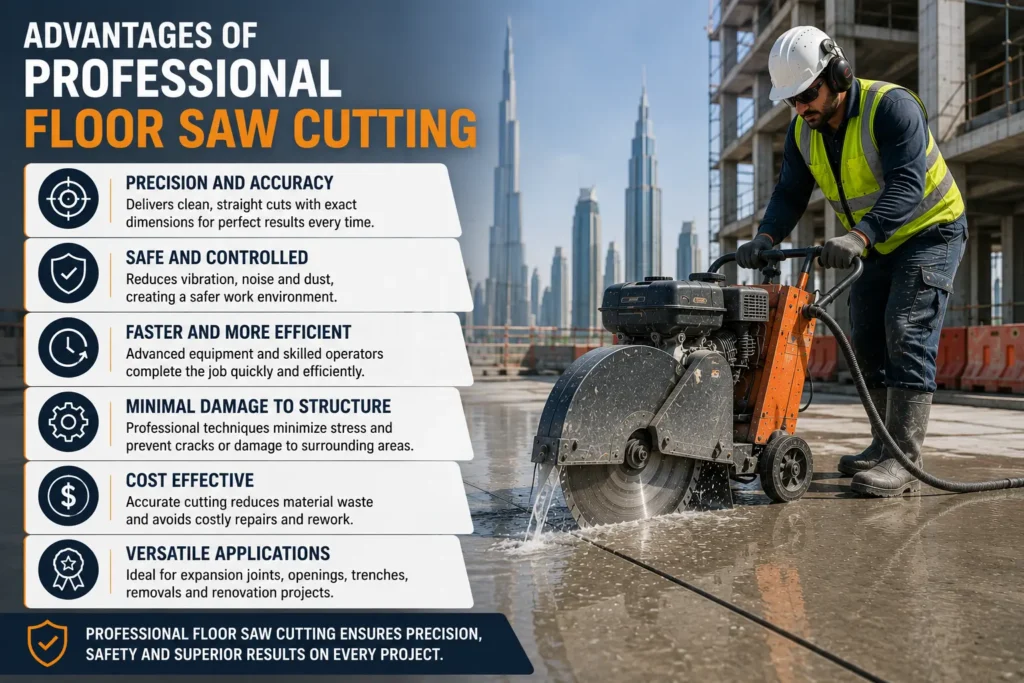
Professional Concrete Floor Saw Cutting offers several practical advantages for construction and renovation projects.
High Accuracy
The cutting line can be planned and followed precisely.
Controlled Removal
Only the required concrete section needs to be separated.
Reduced Unnecessary Damage
Controlled cutting can minimize unnecessary impact on surrounding areas.
Efficient Construction
Professional equipment can handle substantial cutting work efficiently.
Cleaner Cutting Lines
Diamond blades produce defined cutting edges that make subsequent construction work easier.
Better Project Coordination
When the cutting layout is planned in advance, other contractors can coordinate their work more effectively.
Professional Site Preparation for Floor Saw Cutting
Proper preparation is one of the most important parts of a successful floor cutting project. Even advanced equipment cannot deliver the desired results if the site has not been prepared correctly.
Before Concrete Floor Saw Cutting begins, the work area should be inspected and prepared according to the project requirements.
Clear the Cutting Area
All unnecessary tools, construction materials, furniture, machinery, and loose objects should be removed from the cutting area.
A clear working space allows the operator to move the machine safely and maintain a consistent cutting path.
Establish the Cutting Zone
The cutting area should be clearly identified so workers and other people on the site know where the equipment will operate.
Safety barriers or warning signs may be required depending on the project environment.
Confirm the Cutting Layout
The marked cutting lines should be checked before the machine starts.
The contractor should confirm:
- Cutting length
- Cutting direction
- Cutting depth
- Starting point
- Ending point
- Concrete removal area
This final check helps prevent expensive mistakes.
Check Access Conditions
Floor saws can be large and heavy machines. The contractor should confirm that the equipment can reach the required location.
Access considerations may include:
- Door dimensions
- Ramp access
- Parking access
- Floor loading conditions
- Working space
- Equipment transportation
Planning access in advance can prevent unnecessary delays.
Safety Considerations Before Cutting
Concrete floor cutting involves rotating diamond blades, heavy machinery, concrete dust, noise, and potentially concealed utilities.
For this reason, safety planning should begin before equipment operation.
Professional technicians should consider:
- Existing electrical systems
- Underground utilities
- Water lines
- Drainage pipes
- Structural elements
- Nearby workers
- Equipment movement
- Dust generation
- Water and slurry
- Noise levels
Appropriate personal protective equipment should also be used.
This may include safety helmets, eye protection, hearing protection, gloves, safety footwear, and suitable respiratory protection where required.
Managing Dust During Floor Cutting
Concrete cutting can generate fine particles, particularly when dry cutting is used.
Excessive dust can affect visibility, cleanliness, equipment, and worker comfort.
Depending on the project, dust control can involve:
- Wet cutting
- Industrial vacuum systems
- Local extraction
- Controlled work zones
- Appropriate respiratory protection
The selected dust control method should match the equipment and site conditions.
For indoor projects, dust management is especially important because nearby rooms, equipment, furniture, and finished surfaces may need protection.
Managing Water and Concrete Slurry

Wet cutting can be highly effective for controlling dust and managing blade temperature, but it creates another consideration: slurry.
Concrete slurry consists of water mixed with fine concrete particles.
If it is not controlled properly, it can spread across the work area and create:
- Slippery surfaces
- Difficult cleanup
- Drainage problems
- Damage to nearby finished surfaces
A professional cutting team should plan how water will be supplied and how slurry will be contained, collected, and removed.
This is particularly important in commercial buildings, parking areas, warehouses, and finished properties.
Concrete Floor Saw Cutting for Commercial Buildings
Commercial properties often require floor modifications while other parts of the building remain operational.
Examples include:
- Office renovations
- Retail modifications
- Restaurant upgrades
- Hotel renovations
- Shopping center improvements
- Commercial kitchen installations
In these situations, the cutting process needs to be carefully scheduled.
The contractor may need to coordinate with building management and other trades to minimize disruption.
Professional floor cutting can help define the required work area and reduce unnecessary damage to surrounding surfaces.
Concrete Floor Saw Cutting for Industrial Projects
Industrial facilities frequently use heavy concrete floors designed to withstand machinery, vehicles, and continuous activity.
Modifying these floors can require specialized cutting equipment.
Typical industrial applications include:
- Machinery installation
- Equipment foundations
- Drainage channels
- Utility trenches
- Factory renovations
- Warehouse modifications
- Production area upgrades
Industrial projects may involve thicker or reinforced concrete, so equipment and blade selection become particularly important.
The cutting plan should also account for machinery, production schedules, restricted areas, and worker safety.
Floor Saw Cutting for Parking Areas
Parking structures and parking areas may require concrete cutting for repairs, drainage, utility installation, and structural modifications.
Professional cutting can create controlled lines without unnecessarily disturbing the surrounding pavement.
Before work begins, contractors should consider:
- Vehicle access
- Concrete thickness
- Reinforcement
- Drainage systems
- Existing utilities
- Working hours
- Concrete removal
A properly planned project can reduce disruption to parking operations.
Floor Saw Cutting During Renovation

Renovation projects often involve working with an existing structure rather than a newly constructed floor.
This makes precision particularly important.
For example, a building owner may want to install a new drainage line without removing the entire floor.
Instead of breaking the complete surface, technicians can mark the required route and cut along the planned lines.
This controlled approach can make renovation work more organized and can reduce unnecessary demolition.
Concrete Floor Saw Cutting for Structural Modifications
Some projects require modifications to existing concrete slabs.
These applications can involve structural considerations and should not be treated as ordinary surface cutting.
Before modifying a structural element, the project should be reviewed by the appropriate engineer or qualified professional.
The cutting contractor should then follow the approved drawings and specifications.
This helps ensure that the cutting operation does not interfere with critical structural components.
Common Mistakes During Floor Saw Cutting
Even a professional machine can produce poor results if the project is not planned correctly.
Cutting Without Proper Measurements
Incorrect measurements can result in cuts being placed in the wrong location.
This can create additional repair work and increase project costs.
Ignoring Reinforcement
Reinforced concrete requires appropriate equipment and blade selection.
Failing to consider reinforcement can reduce cutting efficiency.
Not Checking Hidden Utilities
Cutting through an electrical cable or water pipe can cause serious damage.
Existing services should be identified before cutting wherever applicable.
Using an Incorrect Blade
Different materials and concrete conditions require different diamond blade specifications.
Using an unsuitable blade can increase wear and reduce cutting performance.
Applying Excessive Cutting Speed
Trying to complete the work too quickly can place unnecessary stress on the machine and blade.
Controlled operation generally produces better results.
Poor Water Management
When wet cutting is used, uncontrolled water and slurry can create additional site problems.
Proper containment and cleanup should be planned in advance.
Starting Without a Removal Plan
Cutting a large concrete section is only one part of the project.
The contractor should also determine how the separated material will be lifted, transported, and removed.
How to Maintain Floor Saw Equipment
Regular maintenance helps keep floor saw equipment reliable and efficient.
Before and after projects, technicians should inspect:
- Diamond blade condition
- Blade attachment
- Machine controls
- Wheels
- Drive components
- Water connections
- Safety guards
- Power systems
- Engine components where applicable
Worn or damaged components should be repaired or replaced before the equipment is used again.
Proper maintenance can help prevent unexpected downtime and maintain cutting accuracy.
Choosing the Right Concrete Cutting Contractor in Dubai

The contractor you choose can have a major impact on the quality of the final result.
Before hiring a service provider, consider several important factors.
Experience
Choose a contractor with experience handling concrete floors, slabs, reinforced concrete, roads, and other hard surfaces.
Equipment
The contractor should have suitable floor saw equipment for the required cutting depth and material.
Skilled Operators
Modern equipment still requires experienced operators who understand cutting techniques and site conditions.
Safety Practices
A professional company should follow appropriate safety procedures and use suitable protective equipment.
Project Planning
The contractor should understand the cutting layout, dimensions, depth, access requirements, and concrete removal process before starting.
Clear Communication
Good communication between the contractor and client helps prevent misunderstandings about cutting locations and project requirements.
Why Choose Concrete Contractor Dubai
Concrete Contractor Dubai provides professional concrete cutting solutions for construction, renovation, modification, and demolition requirements in Dubai.
Our approach focuses on precision, safety, suitable equipment, and efficient project execution.
Professional concrete cutting requires more than simply operating a saw. It involves understanding the surface, evaluating the site, selecting appropriate equipment, planning the cutting layout, and controlling the operation from beginning to completion.
Our experienced team can assist with different concrete cutting requirements, including floor cutting and other specialized concrete services.
Whether the project involves a residential property, commercial building, warehouse, industrial facility, parking area, or construction site, the cutting method can be selected according to the specific requirements of the project.
Frequently Asked Questions
What is Concrete Floor Saw Cutting?
Concrete Floor Saw Cutting is a professional method of making controlled horizontal cuts through concrete floors, slabs, roads, pavements, and other hard surfaces using specialized diamond cutting equipment.
What is a floor saw used for?
A floor saw can be used for utility trenches, drainage installation, expansion joints, concrete repairs, pavement modifications, structural construction work, and controlled concrete removal.
Can a floor saw cut reinforced concrete?
Yes. Suitable floor saw equipment and diamond blades can cut reinforced concrete, depending on the thickness, reinforcement, concrete condition, and required cutting depth.
How deep can a concrete floor saw cut?
The cutting depth depends on the machine, blade diameter, concrete thickness, and equipment specifications. The required depth should be confirmed before starting the project.
Is floor saw cutting suitable for indoor projects?
Yes. Floor saw cutting can be performed indoors when suitable equipment, access, ventilation, dust control, and water management arrangements are available.
Does concrete floor cutting create dust?
Dry cutting can produce concrete dust. Wet cutting and appropriate dust extraction methods can help control airborne particles.
Which is better, wet cutting or dry cutting?
There is no single method that is best for every project. The correct method depends on the material, location, equipment, dust requirements, water availability, and project conditions.
Can floor saw cutting be used for drainage installation?
Yes. Floor saw cutting can create controlled channels for drainage pipes and other underground utility systems.
Is floor saw cutting suitable for road repairs?
Yes. Specialized floor saw equipment can be used for certain concrete and asphalt road and pavement cutting applications.
How long does concrete floor cutting take?
The duration depends on the cutting length, depth, concrete strength, reinforcement, equipment, access, and overall project size.
Can floor saw cutting damage the surrounding floor?
Professional controlled cutting is designed to limit unnecessary damage. Proper planning, suitable equipment, and experienced operation are important for achieving accurate results.
Why should I hire a professional concrete cutting company?
Professional contractors have trained operators, specialized diamond equipment, proper safety procedures, and experience with different concrete conditions.
Conclusion
Concrete Floor Saw Cutting is an important solution for construction, renovation, repair, utility installation, and controlled concrete removal projects. By using specialized floor saw equipment and diamond blades, contractors can create accurate cutting lines through concrete floors, slabs, pavements, and other horizontal surfaces.
If your project requires accurate floor cutting, make sure the contractor understands the concrete thickness, reinforcement, required cutting depth, cutting layout, access conditions, and purpose of the work before beginning.
Get Professional Concrete Floor Saw Cutting in Dubai

If you need reliable Concrete Floor Saw Cutting for a construction, renovation, utility, repair, or concrete removal project in Dubai, professional planning and experienced technicians can make a significant difference.
Concrete Contractor Dubai can provide a suitable cutting approach based on your project requirements, surface conditions, required dimensions, and site environment.